 The Modest Goose
It would be convenient if your bank sent you a note at the end of the month saying, ‘Well done, you are slightly less financially precarious than you were in October.’ It generally doesn’t. The job of working that out is yours.
I like the idea of a monthly money close: twenty minutes to see what came in, what went out, what you kept and what you need to prepare for. It doesn’t need to be a forensic investigation of every coffee.
The four numbers worth gathering
I would keep two records: a balance sheet for assets and liabilities, and a cash-flow statement for money received and spent. Use a consistent closing date, ideally around month-end. Keep a separate forecast for large expenses and expected irregular income.
For cash flow, transfers between your own accounts are not new income or spending. Credit card purchases and subsequent card payments should not both count as spending if you track purchases on the date they occur. Choose a simple method and reconcile it with your account balances.
Twenty minutes, preferably with a cup of tea
Spend the first five minutes updating balances. Record cash, investments, retirement accounts and outstanding debts. Use sensible current estimates for assets that do not have daily prices.
The next five minutes are for cash flow: record salary and other cash receipts, spending and contributions. Compare the result with what you expected. Investigate the big differences rather than reviewing every transaction individually.
Spend five minutes looking forward. What bills will arrive next month? Are there annual premiums, travel payments or tax obligations that need cash reserved? Finally, use the remaining five minutes to choose one action and save a dated copy. The first setup may take longer than twenty minutes; the routine becomes quicker once the spreadsheet is established.
Where did the extra $1,500 go?
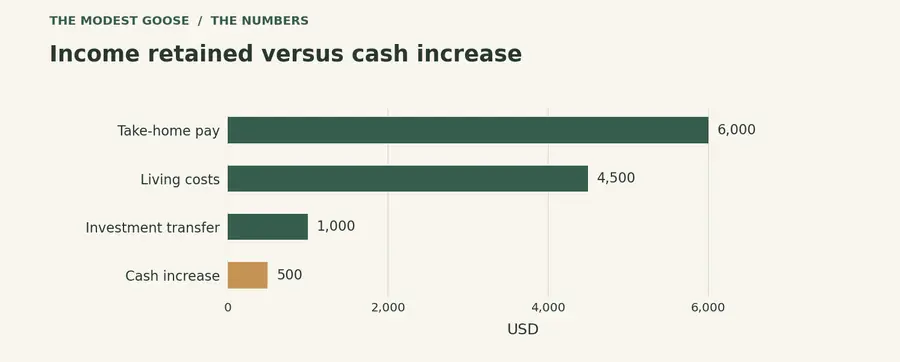
Say the month begins with $12,000 in cash. You take home $6,000, spend $4,500 on living costs and transfer $1,000 to investments. Assume no other movements.
Take the $6,000 in receipts, subtract $4,500 of living costs and the $1,000 transferred to investments: cash rises by $500. The bank balance is now $12,500.
But you actually retained $6,000 − $4,500 = $1,500 from that month’s pay, a savings rate of 25%. One thousand dollars moved from one account to another; it didn’t vanish. If your monthly review treats every transfer as an expense, it will give you a surprisingly gloomy view of a perfectly good month.
Suppose existing investments fell $2,000 in market value that month, excluding the new contribution. Assuming no other asset or debt changes, net worth fell by $500 despite positive saving. That is quite a different story from simply looking at a red number in your portfolio.
One decision is enough
If spending was unusually high, distinguish a one-off payment from a new recurring cost. If net worth fell, distinguish market movements from spending. If your cash reserve will be inadequate next month, decide what can be adjusted now.
I like having one short note next to each month: what changed and what I intend to do. It saves trying to remember in December why there was a mysterious expense spike in February.
Get the numbers ready first
I would also identify irregular payments that are easy to forget: annual insurance premiums, professional subscriptions, tax instalments and travel bookings. They belong in the cash forecast even if they do not fall in the current month. A monthly review is particularly valuable when it gives you warning about a future payment rather than simply confirming one that already happened.
Why did net worth change?
A simple way to understand the difference between two balance sheets is to build a bridge between the opening and closing figures. Start with net worth at the end of the previous month. Then record the money retained from income, changes in investment values, changes in major asset estimates and any other relevant adjustments. If you track debt principal separately, make sure it is not already included in the retained-money measure. Add the components and compare them with the actual closing net worth.
For example, suppose you begin with $250,000 of net worth, retain $2,000 from income and experience $3,000 of investment gains. Assuming no other movements, your new net worth is $255,000. If you had made exactly the same savings contribution but the investments fell by $3,000, the new figure would be $249,000 instead. Your savings behaviour was identical in the two situations. The market outcome was not.
This distinction is useful because it prevents you from drawing the wrong conclusion from a single month. It also helps you notice if a transfer, liability or asset value has been recorded incorrectly. A large unexplained difference is worth investigating before relying on the numbers.
Leave the insignificant transactions alone
I would avoid making detailed tracking an indefinite requirement merely because the first investigation was useful. Once you know which categories matter, focus attention there and simplify the rest. The objective is a clear enough picture to make decisions, not a flawless record of the price of every sandwich purchased during the year.
Keep sensitive documents in a secure place and be careful about sharing financial spreadsheets. A record of account balances and debts can contain a surprising amount of private information even if you have removed account numbers. Back up the workbook or retain version history so that an accidental edit does not erase past months. When the next review comes around, you should be able to open the existing file, update the relevant figures and finish with a practical action. The best routine is the one you can still be bothered to do in an ordinary, busy month.
The point of the monthly close is not to establish that every dollar behaved itself. It is to catch the things that will matter next month, make one sensible adjustment and then get on with the weekend.
Education only, not financial advice. This article is general information, not a recommendation to buy, sell or hold anything. Examples are illustrative. Check current rules for your country, and consider a licensed adviser for decisions about your own situation. Full disclaimer.