 The Modest Goose
Having money in several currencies is a perfectly reasonable arrangement. It is also a delightful way to make a simple net-worth spreadsheet produce a different answer on two consecutive days, even when you haven’t spent anything.
The trick is to keep each balance in its original currency and translate it into one reporting currency on a consistent date. That separates your actual savings from whatever the foreign exchange market happened to do this month.
Pick the currency of your future bills
Choose the currency most relevant to your major spending and financial goals. For someone living in London with predominantly sterling obligations, GBP may be more useful than USD even if most investments trade in dollars. Someone planning to settle elsewhere may reasonably track a secondary reporting view.
Keep the original-currency balance and exchange rate in separate columns. Use an explicitly defined rate convention: reporting currency units per one unit of foreign currency. Multiply the original balance by that rate. For the reporting currency itself, the rate is one.
The day your pounds earned dollars without interest
Suppose a person reports in USD and holds GBP 20,000, EUR 10,000, USD 40,000 of investments and a USD 5,000 liability. Assume rates of $1.25 per pound and $1.10 per euro. These are made-up rates, not market quotations.
The pounds translate to £20,000 × $1.25 = $25,000. The euros translate to €10,000 × $1.10 = $11,000. Add the $40,000 of investments and we have $76,000 in assets. Subtract the $5,000 debt and net worth is $71,000.
If the pound strengthens but those £20,000 remain untouched, the dollar value rises. I would keep the pound figure in the sheet rather than overwrite it with dollars. Otherwise it is very hard to tell whether a subsequent increase came from actual saving or a favourable conversion.
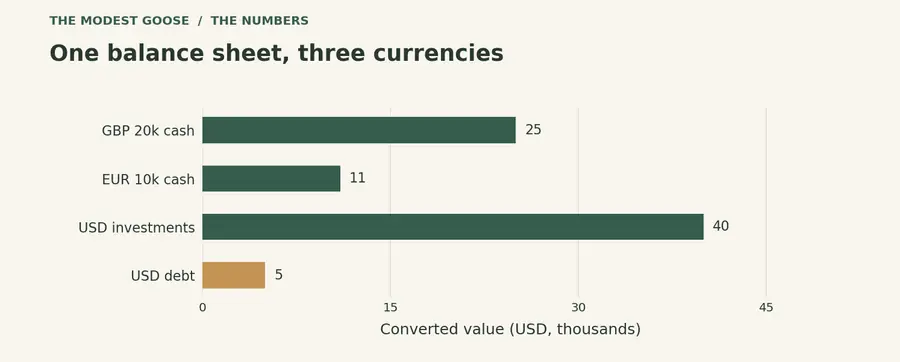
If the pound falls to $1.20 and all other balances remain unchanged, sterling cash converts to $24,000 and net worth falls to $70,000. No money was spent. The reporting currency simply values the same pounds differently.
A transfer is not new income
A transfer between your own accounts does not create income. Record the amount leaving one account, the amount received in the other and any fees separately. If the transfer is still pending at the reporting date, reconcile it so that the same money is not counted twice or omitted entirely.
For an investment fund priced in one currency but holding assets in another, use the fund’s current quoted value for the balance sheet. Its underlying currency exposure is a separate risk analysis. Do not convert the underlying holdings again on top of the fund value.
My monthly currency check
Record the closing date, original currency, original amount, rate and converted amount. Apply rates from a consistent source and date. Keep major foreign-currency obligations visible; a future tuition payment in euros creates a different risk from a purely domestic expense.
If you want to understand changes in wealth, compare each asset’s original-currency balance before looking at translated totals. This can reveal whether the movement came from additional saving, local investment performance or currency translation. It is much more informative than celebrating a rise in the reporting currency without knowing why it happened.
A spreadsheet that keeps the original numbers
I would use one row per account, property, investment balance or liability. Record its name, category, original currency, original amount, conversion rate and translated amount. You can keep the exchange rates in a separate small reference table, then look them up by currency. This reduces the chance of using three different exchange rates for the same currency simply because you entered three accounts at different times.
For a monthly report, preserve the rates used for that month. If the entire historical workbook relies on one live rate that changes every day, the reported value of last year’s assets may change whenever you open the file. That rather defeats the purpose of keeping historical snapshots. A dated rate table or a saved month-end copy of the figures is a straightforward solution.
I would also add an access or purpose column. Perhaps some of the pounds in your UK account are earmarked for a future tax bill, while your euros are intended for a family expense. Knowing the dollar equivalent of the total is helpful, but knowing which currencies you actually need to spend is more important when planning those commitments.
Separate saving, investment returns and exchange rates
Suppose you hold an investment worth EUR 10,000 at the beginning of a month, when one euro is worth $1.10. At month-end, the investment is worth EUR 11,000 and the exchange rate is $1.05 per euro. There were no purchases, sales or distributions during the month. These are invented numbers.
Your opening translated value is $11,000. Your closing translated value is $11,550, an increase of $550. You can break the change into two components using a consistent convention. First, the EUR 1,000 local investment gain translated at the opening rate adds $1,100. Second, applying the rate change of negative $0.05 to the ending balance of EUR 11,000 subtracts $550. The combined result is $550.
This is one way to assign the interaction between the local price movement and the exchange-rate movement. Other consistent attribution conventions can work too. The useful part is that you can see why the translated gain of 5% differs from the local investment gain of 10%. It is not necessarily evidence that the investment performed poorly.
If you add or withdraw money during the month, separate those flows from performance. A simple monthly balance comparison is not a precise investment return calculation when the timing of contributions matters. It is still useful for personal financial reporting, provided you understand what it measures.
Match the money to its intended use
Not all your assets need to be in the same currency as your current salary. However, a large known expense in another currency deserves particular attention. If you expect to pay EUR 20,000 in tuition in a year’s time, a rise in the euro against your reporting currency can increase the amount you need to set aside.
I would track such commitments in their actual payment currency and model what a less favourable exchange rate would mean. Do not assume that a foreign-currency investment automatically hedges the expense simply because its quoted price appears in that currency. Its market value can fall, and its underlying economic exposure may be different.
You can make the first version of a multi-currency tracker relatively simple. Consistency matters far more than an elaborate live data feed. Record the amounts you actually have, use rates from a consistent date and keep near-term currency needs visible. Once you have done that, the question changes from ‘how much do I have?’ to ‘what can this money reasonably be used for?’ That is a more useful place to begin planning.
The exchange rate is not a scoreboard for your personal discipline. Keep the original balances visible and use conversions to understand your position, not to congratulate yourself on a fortunate currency movement.
Education only, not financial advice. This article is general information, not a recommendation to buy, sell or hold anything. Examples are illustrative. Check current rules for your country, and consider a licensed adviser for decisions about your own situation. Full disclaimer.