 The Modest Goose
Cash has a habit of looking rather lazy during a good year in the stock market. Then the car needs a repair, the boiler stops working or your job unexpectedly disappears, and suddenly the laziest part of your portfolio is doing all the work.
How much cash you should hold depends less on your portfolio size than on your bills and the risks in your life. I’d start with the months you could go without employment income and then add money you’ve already promised to spend.
Cash for an emergency, not for a holiday
An emergency fund is readily accessible money set aside for unforeseen events such as income interruption or essential repairs. It should be distinguishable from money reserved for a holiday, a tax bill or a home deposit. Those expenses are not emergencies if you already know they are coming.
For this purpose, cash includes readily accessible savings and cash-equivalent balances whose value and access terms you understand. Investments with price risk and unused credit limits are not equivalent. A credit facility may be useful, but it is borrowing, not a reserve.
The six-month scenario
Suppose a household needs $3,500 a month for rent or mortgage, basic food, utilities, insurance, transport and minimum debt payments. It chooses a six-month stress scenario, rather than a universal rule.
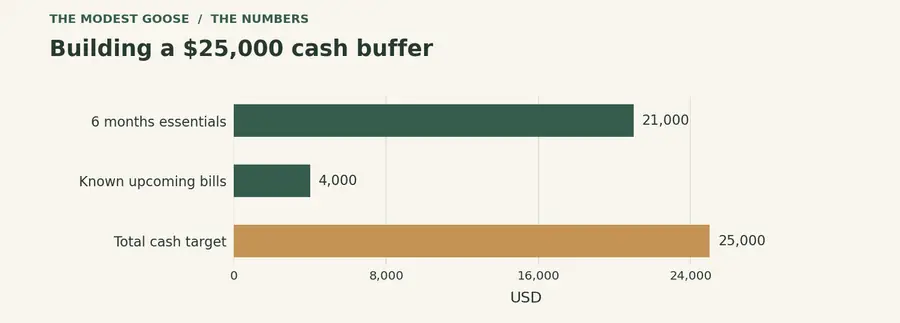
Six months of the essentials adds up to $3,500 × 6 = $21,000. There is also $4,000 of tax and insurance due over the coming year. Those bills are going to arrive whether or not there’s an emergency, so don’t spend the same cash twice.
In this example I would write down $21,000 + $4,000 = $25,000 as the combined cash requirement. The two buckets have different jobs. If the household changes its emergency scenario to three months, the first bucket changes; the bills do not.
With $18,000 currently available and no separate funds already earmarked, the shortfall is $7,000. Saving $700 a month would cover it in ten months, ignoring interest and further changes.
When six months might be too little or too much
A household with two independent stable incomes might tolerate a different buffer from a single-income household with a large mortgage. Variable compensation, dependent relatives, uncertain health costs and a planned career break all matter. So do benefit coverage and the time it may take to find comparable employment.
Think about what an interruption actually looks like. How much would you continue spending? Which bills are contractual? Are any assets readily available? Are there expenses you would stop immediately? Build the estimate using the reduced but realistic budget, not an optimistic version in which nothing goes wrong except your salary.
What cash buys you besides interest
I would first list the money needed for known near-term commitments, then calculate a reserve under a plausible adverse scenario. Only then consider which remaining funds are genuinely long-term. It is possible to hold too much cash for long-term objectives, just as it is possible to hold too little for immediate needs.
Rather than debating one ideal allocation, review the buffer when your life changes. A home purchase, new child or change in employment may matter more than the latest market forecast.
Why a portfolio percentage misses the point
Imagine two households with $200,000 in financial assets. One spends $2,500 a month on essentials, while the other spends $7,000. Holding 10% in cash would give both $20,000. That covers eight months for the first household and less than three months for the second. The appropriate comparison depends on expenses and other resources, not just the size of the portfolio.
I would calculate a dollar target first and then look at what that implies for the overall asset allocation. As your wealth grows, the emergency cash amount may remain fairly stable unless spending and obligations change. As your responsibilities increase, it may need to rise even if the value of your investments has not changed.
The bills that don’t disappear when work does
Start with housing, utilities, groceries, insurance, essential transport, necessary healthcare and contractual debt payments. Include financial commitments to other people where they cannot easily be reduced. Review annual or quarterly costs that might fall during the assumed period of disruption. If a bill will be due within that window, it needs to be accounted for somewhere.
Then separate expenses that you could realistically reduce. It is possible to spend less during a difficult period, but assuming you can eliminate almost every non-essential expense overnight may be optimistic. Make a budget that you would actually be able to live with for the number of months you are modelling.
For a household with two incomes, consider the effect of losing one rather than both. The remaining salary may cover a substantial portion of costs, so the reserve might need to fund the monthly gap rather than the entire expenditure. A separate, more severe scenario can show what happens if both incomes are affected. If the two people work for the same employer or in the same industry, the combined scenario may be particularly worth examining.
Don’t mix the home deposit with emergency money
A spreadsheet can handle this without opening a different bank account for every goal. Make a simple allocation table with the total accessible balance, money reserved for emergencies, money committed to known expenses and the remaining unallocated amount. Check that allocations do not exceed the actual balance. This is particularly helpful when several large payments are due around the same time.
Where you hold the money also matters. Check access conditions, any notice periods, applicable deposit protection rules and the possible cost of early withdrawal. A higher quoted interest rate may come with conditions that make an account less useful for the immediate emergency portion of your reserve. The details vary by jurisdiction and product, so review the actual terms.
I like to think of cash as something that gives you time to make decisions without being forced into them. You may not need to use it very often. That is precisely the point. The goal is not to keep the biggest possible pile of cash, but to avoid depending on an inconvenient sale, expensive borrowing or an employer’s generosity when something important needs paying for.
The cash buffer doesn’t have to win a performance contest. Its job is to be there when the rest of your financial life becomes inconvenient. Decide what that job is worth to you, then give it a sensible amount of money to do it.
Education only, not financial advice. This article is general information, not a recommendation to buy, sell or hold anything. Examples are illustrative. Check current rules for your country, and consider a licensed adviser for decisions about your own situation. Full disclaimer.