 The Modest Goose
Imagine being worth half a million dollars and putting a broken washing machine on a credit card because the money is mostly in your house. You haven’t necessarily got a wealth problem. You’ve got a rather inconvenient cash problem.
Net worth is everything you own less everything you owe. Liquid net worth asks how much of that position is available without selling the furniture, the house or the next twenty years of retirement income. I would happily track both. They are very different numbers.
Two measures of the same household
The house, the car, the pension and the investments all belong on a normal net-worth statement, less the debts. Cash and marketable investments go in the liquid column. Shares may be quick to sell but aren’t necessarily going to be worth what they were yesterday. A retirement account with withdrawal restrictions belongs in a different category again.
There is no single universal definition of liquid net worth. Some people subtract all liabilities from liquid assets; others subtract only debts payable soon. I prefer to show both liquid assets and short-term obligations separately, so I can see exactly what a number represents. Don’t quietly switch definitions halfway through tracking your progress.
A surprisingly wealthy household with only five months of cash
Suppose you have $30,000 in cash, $90,000 in accessible investments, $150,000 in retirement accounts and a $600,000 home. You owe $350,000 on your mortgage and $5,000 on a credit card.
Add the four assets: $30,000 + $90,000 + $150,000 + $600,000 = $870,000. Subtract the $355,000 of debt ($350,000 mortgage and $5,000 card balance) and you’re worth $515,000.
Now try to pay a bill. The $30,000 in cash and $90,000 in marketable investments give you $120,000 of liquid assets. Pay the credit card from that and there is $115,000 left. If you use the stricter definition and subtract every liability, including the mortgage, liquid net worth is negative $235,000. A negative number under that definition doesn’t mean the household has no money; it means most of the debt is backed by assets we excluded from the calculation.
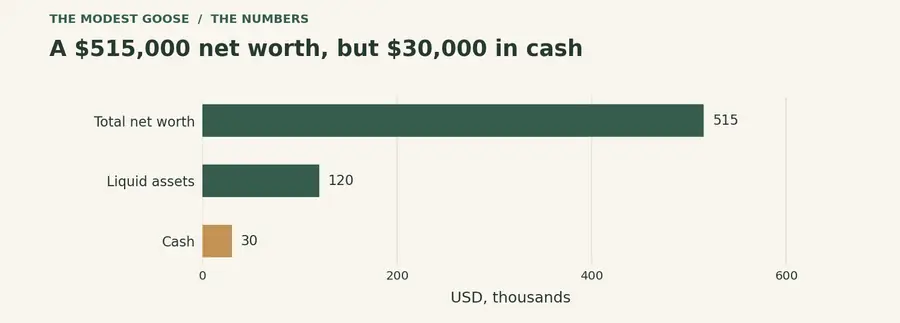
If essential monthly spending is $6,000, cash alone covers five months before considering the credit card payment. After paying that card balance from cash, the buffer is just over four months. This is the number I would look at before taking an unpaid break from work.
How quickly can it pay a bill?
Think about the journey from your account statement to paying a bill. Cash in a current account takes almost no effort. A deposit might have notice requirements. A listed investment may take time to settle, and selling it could create a tax bill. A private business may have no obvious buyer at all.
I would separate accessible cash, saleable investments and restricted assets rather than give everything an arbitrary liquidity discount. Where there is a real withdrawal penalty or estimated transaction cost, make a separate adjustment and document it. Never assume a credit line is cash you already own.
The three numbers I would keep
I’d write down three numbers at month-end: net worth, cash that isn’t already promised to someone, and investments I could realistically sell. Then add the bills due soon. It takes very little extra effort once you have the accounts in front of you.
There is a temptation to maximise the net worth number by keeping every spare dollar invested. It can look wonderful until two inconvenient things happen at once: income stops and investments fall. A simple stress test helps. Reduce the investment portfolio by an illustrative 25% and assume no salary for three months. What bills can you still cover without relying on borrowing?
I wouldn’t treat a low liquid-assets ratio as a moral failing. Someone who has just bought a home might reasonably have a smaller buffer than someone who plans to rent indefinitely. What matters is whether the next few financial commitments fit the resources actually available.
Same wealth, entirely different options
Give two people $400,000 each in net worth. One owns a home they intend to occupy for twenty years; almost all their wealth is in it. The other rents and keeps most of their balance sheet in cash and investments. A wealth league table cannot distinguish them. The first may have housing stability; the second may be able to relocate without selling a house. Neither gets to have all the advantages.
The first person may enjoy the stability of home ownership, have a manageable mortgage and expect their housing costs to fall eventually. The second may find it easier to relocate, fund a career change or make a large payment without borrowing. They may also face the uncertainty of rent increases and have more exposure to financial markets. Neither arrangement automatically wins. Each has a different mix of risks and benefits.
Make the spreadsheet tell you what is available
Add a column called ‘Access’ next to your list of assets. Start with three categories: readily available, marketable and restricted. A fourth category for assets that require a substantial transaction, such as property, can make the distinction even clearer. Then total each category separately.
For liabilities, use a similar distinction. Record amounts that need to be paid soon, regular contractual payments and longer-term debt balances. Your mortgage principal is part of your liabilities, but unless you intend to redeem it or are required to do so, it is the regular payment that normally matters for next month’s spending plan. This is why one definition of liquid net worth cannot replace a cash-flow forecast.
An account labelled ‘Savings’ is not necessarily available in full. If $10,000 of the $30,000 in your example bank balance is earmarked for an upcoming deposit, show it separately. You still own that money and it belongs on your balance sheet until it is paid. But only $20,000 is uncommitted for the purpose of planning an emergency reserve.
Cash is useful; it is not the only useful asset
Not necessarily. Holding money in readily accessible accounts can involve an opportunity cost if it prevents you from funding worthwhile long-term goals. The purpose of separating your wealth by accessibility is to make the trade-off visible, not to declare one kind of asset superior to every other kind.
The balance sheet is allowed to look less impressive if the real-life result is a little more freedom. I’d rather know I have choices than spend my Sunday admiring a seven-digit number.
Education only, not financial advice. This article is general information, not a recommendation to buy, sell or hold anything. Examples are illustrative. Check current rules for your country, and consider a licensed adviser for decisions about your own situation. Full disclaimer.