 The Modest Goose
Employer stock can be a lovely part of a compensation package. It can also give you the unusual privilege of worrying about your investments and your job during exactly the same earnings announcement.
There is no single percentage of employer stock that is right for everyone. But I would look at the share of my investment portfolio, the share of my net worth and the amount of my future income that depends on the company before deciding that the exposure is modest.
Two percentages, not one
Start with shares you currently own, including vested shares delivered to your brokerage account. Keep unvested awards in a separate compensation forecast. Compare your employer stock against your accessible investment portfolio, financial assets and total net worth, stating each denominator clearly.
A property-heavy household may appear diversified when measured against total assets but have a concentrated investment portfolio. Neither metric is wrong; they answer different questions.
What a bad quarter could do
Suppose a household has $60,000 in employer stock, $90,000 in other market investments, $30,000 cash and $120,000 home equity, with no other assets or liabilities.
Of $150,000 in market investments, $60,000 is employer stock, so the portfolio concentration is 40%. Of total net worth of $300,000, the stock is 20%. Both figures are correct; they describe different things.
If the shares fall 40%, the loss is $60,000 × 40% = $24,000. Net worth becomes $276,000, other things being equal. And that’s before considering whether the event that sent the share price down might also have consequences for the household’s job or next bonus.
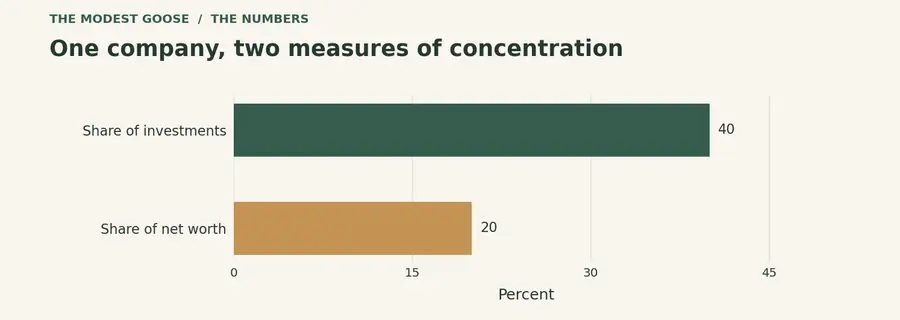
If a job loss occurs at the same time and essential spending is $5,000 a month, the $30,000 cash reserve covers six months before other adjustments. That is a different risk from the share price loss. Future unvested awards might also be affected.
Where concentration becomes uncomfortable
Set a stress scenario instead of borrowing an arbitrary percentage from someone else’s portfolio. Ask whether a large decline would affect a home purchase, retirement timeline or ability to cover living expenses. Consider tax costs, trading restrictions and company policies before deciding how to handle shares.
I would distinguish between choosing to buy company stock today and continuing to hold shares because they arrived through payroll. Receiving something as compensation does not automatically mean it is the investment you would choose with cash. Equally, there may be reasons to hold it; the purpose is to make the decision consciously.
The shares you haven’t received yet
Forecast them separately under several stock-price and employment scenarios. A grant that has not vested is not the same as a share you own. An impressive total compensation figure can hide the fact that much of it depends on one variable.
Your job is already an exposure to the company
Most employees already have a significant financial relationship with their employer before receiving a single share. Their salary may cover the mortgage, retirement contributions and everyday living costs. Benefits and future promotions may also depend on the organisation continuing to perform reasonably well. Equity compensation adds investment exposure to that existing income dependence.
Consider what can happen during a difficult period for a company. The share price may decline as investors anticipate weaker results. Discretionary compensation may be lower, and the organisation may reconsider staffing. These events do not always happen together, but they are related enough that treating them as completely independent risks can be misleading.
This does not mean someone employed at a public company should never hold its shares. It means that confidence in the business is only one part of the decision. The household’s dependence on that business deserves attention too. A person who has enough independent resources to fund major commitments may have a different tolerance for concentration from someone whose near-term plans depend heavily on future vests.
Compensation and investment are different decisions
I would maintain two separate calculations. The first shows what you currently own and how much of it is invested in employer shares. The second shows the anticipated value of future equity compensation over a defined period. The second is a forecast, not part of your existing investment balance.
For example, suppose you own $60,000 of employer stock and expect another $40,000 of gross equity compensation over the next year at the current share price. A 40% decline would reduce the existing shares by $24,000 and the expected gross award value by $16,000, assuming the same number of units eventually settles. These are two different consequences of the same price movement. Do not add the full future award to the balance sheet today and then subtract it again as a loss.
You can take the analysis further by considering the net amount after estimated payroll deductions. Keep the assumptions visible, because the actual value and timing of awards may change. If a substantial part of a future home deposit is supposed to come from equity, model the lower-price scenario before agreeing to the purchase.
A regular check beats constant monitoring
If you have an intended limit or target range, document why it makes sense for your situation. Consider what happens in a plausible downturn and whether important obligations remain affordable. If you decide to make changes, account for the applicable tax implications, employer policies and restrictions on trading. In some circumstances, you may need professional advice or compliance clearance.
Another useful question is whether a recent increase in concentration came from a conscious investment decision or simply from the way compensation was delivered. The two can look identical on a portfolio statement. They are not necessarily identical in terms of your intentions. Reviewing that distinction occasionally helps ensure your portfolio reflects decisions you actually meant to make, rather than a series of administrative defaults.
A falling concentration percentage also deserves a little context. It could result from adding other investments, selling employer shares or a decline in their market value. Those outcomes have very different implications for the household, even though they all reduce the percentage. Record the underlying amounts as well as the ratio so that the reason for the movement remains visible.
It is possible to like your employer, enjoy your job and still prefer not to have your financial future depend on a single boardroom. I would make that a deliberate decision rather than let years of vesting make it for me.
Education only, not financial advice. This article is general information, not a recommendation to buy, sell or hold anything. Examples are illustrative. Check current rules for your country, and consider a licensed adviser for decisions about your own situation. Full disclaimer.