 The Modest Goose
A bonus is one of the few amounts of money we can spend in our heads several months before anyone has actually agreed to pay it. By the time it arrives, it may already have financed a holiday, some furniture and a rather optimistic savings plan.
I think of a bonus as uncertain until the money has landed. Even then, there may be taxes or other commitments to allow for. The relevant amount is not the target on your compensation letter, but the portion you can genuinely use.
A target bonus is not an account balance
Discretionary bonuses can depend on personal performance, company results, continued employment and other conditions. Some may be paid in equity or subject to deferral and repayment clauses. Read the actual compensation terms and distinguish guaranteed amounts from targets and potential awards.
A gross bonus also differs from the net cash amount deposited. Payroll withholding may not equal the eventual liability. Tax treatment varies by country and personal circumstances, so use applicable official guidance or a qualified adviser rather than one universal tax percentage.
What happens to the $30,000 you were expecting?
Suppose your target bonus is $30,000 but the actual award is $24,000. Assume $6,000 in payroll deductions and a separate estimated tax reserve of $2,000 beyond those deductions. These are made-up figures, not a tax-rate calculation.
The award is $24,000, not $30,000. Deduct $6,000 from it and $18,000 arrives in the account. Set aside the additional $2,000 tax reserve and there is $16,000 that is available for other purposes.
Then there are $4,000 of annual bills and $7,000 earmarked for savings. What remains unallocated is $5,000. A lovely amount of extra money, but considerably less than the $30,000 you may have been imagining in the department store.
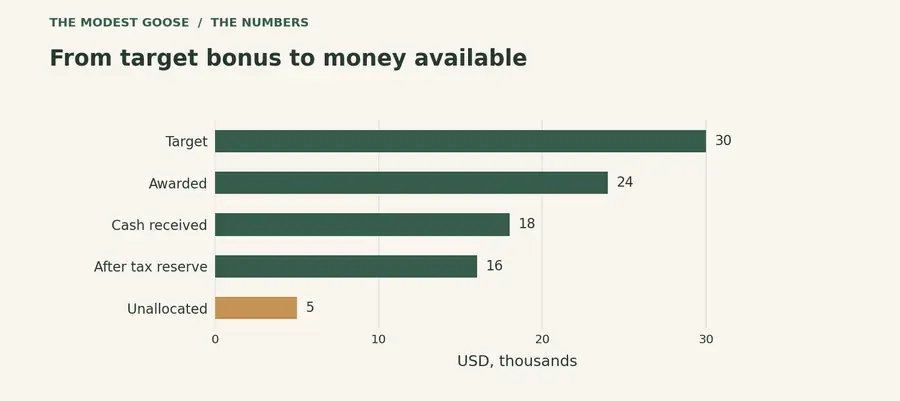
That is considerably less than the original $30,000 number. It also makes the decision much easier because the household is working with money that is actually available.
Make plans, not commitments
Build your recurring household budget around dependable income. Then create a separate schedule for expected variable pay, its likely date and a range of net outcomes. A zero-bonus scenario is useful because it exposes expenses that are only affordable if the bonus arrives.
Once cash is received, reconcile payroll, estimate any remaining tax obligation and allocate the net amount. Consider debt, reserve needs and important upcoming commitments, then decide what to spend or retain. There is no obligation to put every dollar into investments. The important thing is that your choice is based on the real payout.
I would avoid raising permanent monthly commitments on the strength of one particularly good bonus year. A nice holiday is an expense you can choose not to repeat. A larger mortgage is a rather more persistent reminder of last year’s success.
Don’t borrow from an optimistic estimate
I would distinguish a purchase that is affordable from existing resources from one that requires the expected bonus to arrive. In the first situation, you may prefer to make the purchase now and replenish savings later if the bonus is paid. In the second, you are relying on uncertain income, and the decision deserves much more caution.
Check whether the commitment can be cancelled or delayed. Booking a refundable holiday is quite different from committing to a permanent increase in housing costs. If you are about to sign a contract, work out what would happen if the bonus were half the amount expected, paid several months late or not awarded at all. The most useful scenario is often the one you would rather not think about.
There is also a timing difference between a bonus being announced and being deposited. Some awards are contingent on continued employment until a specific date, and some contain repayment or deferral conditions. Do not assume an award has become unrestricted cash just because you have received a compensation statement. Check the terms and the actual payment date.
Decide where the money goes once it arrives
I like to start with commitments that are already due or planned. Check whether any additional tax needs to be reserved and whether annual expenses have been funded. Then look at your accessible cash, outstanding liabilities and the goals you have already identified. Once those amounts are understood, it becomes easier to decide how much to retain and how much to spend.
Consider a household that receives a $12,000 net bonus and has a planned insurance bill of $2,000, a $4,000 gap in its cash reserve and $6,000 remaining towards a home project. Those three commitments add up to the whole bonus. That does not mean the household is obliged to fund every one of them immediately. It does reveal that any additional discretionary purchase would require a change somewhere else in the plan.
I would avoid treating bonus allocation as a contest in which the highest possible savings percentage wins. If you have taken care of important financial commitments and want to use some of the money for something enjoyable, that can be a conscious part of the plan. Giving every portion a purpose is more helpful than accidentally spending it in several different places.
Plan your life on dependable income
For a cash-flow plan, maintain a dependable-income case that covers ordinary obligations and a separate case with an estimated bonus. Include a lower scenario if the household is considering a significant purchase. The difference between the forecasts shows how much of your financial plan depends on variable compensation.
Finally, remember that an award paid in shares has an additional uncertainty: the price at which those shares become available or are eventually sold. Keep that risk separate from cash bonus assumptions, and update the forecast when the real amounts are known. A good year at work is certainly something to celebrate. It is much nicer to celebrate after the money has arrived and you know what you actually have to work with.
A calendar reminder to revisit the forecast after the compensation announcement can be useful. Until then, leave the expected payout in the scenario rather than the actual receipts column. This preserves a clear distinction between the budget you hope to have and the money already in your account.
Enjoy the bonus if and when you get it. One of the more satisfying uses of extra money is being able to choose what to do with it, instead of discovering that you promised it all away in October.
Education only, not financial advice. This article is general information, not a recommendation to buy, sell or hold anything. Examples are illustrative. Check current rules for your country, and consider a licensed adviser for decisions about your own situation. Full disclaimer.