 The Modest Goose
A discounted cash flow valuation, or DCF, is a fancy name for a straightforward question: how much would you pay today for the cash a business might produce in the future? The complications arrive when we have to guess how much cash that will be, how long it will last and what return we need.
I like the DCF because it forces those guesses out into the open. It isn’t necessarily the fastest way to make money in the stock market, but it is a very good way of finding out exactly how optimistic you have been.
Profit is nice. Cash is what we need.
Free cash flow is cash left after the operating expenses, taxes, working capital needs and investment required to run the business. For enterprise valuation, a common measure is unlevered free cash flow: operating profit after tax, plus non-cash depreciation, minus capital expenditure and increases in net operating working capital. It is measured before financing costs. Discount it using a rate appropriate to that cash flow, commonly the weighted average cost of capital (WACC).
Revenue and accounting profit are not the same as cash. A company may report growing sales but need substantial inventory or equipment investment to support that growth. Those costs belong in the forecast.
A small business with $10 million of annual cash flow
Suppose a company generates $10 million of unlevered free cash flow annually for five years. Assume a 10% discount rate, 2% perpetual growth after year five, $15 million of debt, $5 million excess cash and 10 million shares. Ignore other claims and adjustments.
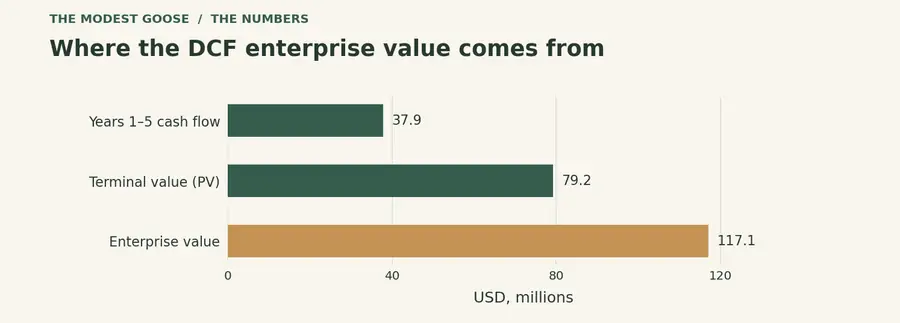
Discount each of the five $10 million annual cash flows using CF ÷ (1 + r)^t, where r is the discount rate and t is the number of years. Together they’re worth approximately $37.91 million today.
We also need a value for what happens after year five. Assuming 2% annual growth forever gives year-six cash flow of $10.2 million. The terminal value at year five is $10.2m ÷ (10% − 2%) = $127.50m. Discount that back five years: $127.50m ÷ 1.10⁵ ≈ $79.17m.
The two amounts together give an enterprise value of $117.08m. That is the value of the operating business, not just the shares. Deduct $15m of debt and add $5m of excess cash, leaving $107.08m for shareholders. Divide by 10 million shares and our model says $10.71 per share. I wouldn’t be especially impressed by the last cent: more than two-thirds of the estimated business value rests on what happens after the explicit forecast.
This is an illustrative estimate, not a target price for an actual business.
Why the answer moves when you touch one assumption
More than two-thirds of enterprise value in this example comes from the terminal value. Small changes in the discount rate or long-run growth rate can materially change the answer. The formula requires the discount rate to exceed perpetual growth; neither should be selected simply to justify a preferred share price.
I would run a grid of plausible discount rates and terminal growth assumptions. Then ask what operating performance would need to occur for the most optimistic case to make sense. A great-looking spreadsheet does not make assumptions great.
Use the model to ask better questions
Compare the valuation range with other approaches, including market multiples and the company’s historical operating performance. Read the annual reports and identify which assumptions actually drive results. A reverse DCF, which asks what future performance the current price implies, can be a helpful alternative to guessing one correct price.
The cash-flow estimates have to come from somewhere
Begin with the company’s financial statements and notes. Look at how revenue has developed, the cost of generating that revenue and the investments required to keep the business operating. Historical cash flow is useful context, but the value of the business ultimately depends on what it may generate in the future. Copying the last five years into the next five is not always a reasonable assumption.
Make sure the cash flow definition matches the valuation approach. Unlevered cash flow is discounted at a rate intended to reflect the cost of debt and equity capital, giving enterprise value. Cash flow available to equity holders is a different measure and should be discounted at the cost of equity. Mixing the cash flows and discount rates will give a misleading result even if the spreadsheet formulas are otherwise correct.
The price of waiting and taking risk
The discount rate reflects the compensation investors would require for the timing and risk of the projected cash flows under the model’s assumptions. In a conventional enterprise DCF, analysts often estimate the weighted average cost of debt and equity capital, taking into account the relevant capital structure and tax treatment. That estimate is not a precise observable number for most businesses.
Using the earlier example, suppose we keep cash flow of $10 million a year, 2% terminal growth, $15 million debt, $5 million excess cash and 10 million shares, but change the discount rate to 12%. The five-year present value falls to about $36.05 million, while the discounted terminal value falls to approximately $57.88 million. Enterprise value becomes about $93.93 million and equity value approximately $83.93 million, or $8.39 per share. A two-percentage-point change moves the illustrative valuation from about $10.71 to $8.39.
This is why I would give a range of discount rates serious attention rather than assume the first one entered is unquestionably correct. It is also why high-growth companies, whose estimated value may rely heavily on cash far into the future, can be particularly sensitive to valuation assumptions.
The perils of forecasting forever
The terminal period is intended to represent a more mature, sustainable phase of the business. It should not automatically inherit the unusually high growth or margins you might expect during the early forecast years. A perpetual growth rate implies the business continues growing at that rate indefinitely, so an aggressive figure has far-reaching consequences.
I would check whether the terminal cash flow is consistent with the investment needed to sustain that growth. If the model assumes strong long-run growth with almost no reinvestment, there may be a disconnect between the operating forecast and the valuation. Consider a separate scenario with lower growth, greater reinvestment or a gradual transition to mature operating performance.
The final step is to read the assumptions back as a business story. For the valuation to make sense, what needs to happen to customer demand, costs, competition and investment? Is that story plausible, or does it simply produce the share price you hoped to see? A valuation model is useful because it makes your expectations explicit. The fact that it can calculate an answer to two decimal places is a rather less important feature.
A valuation model should make your uncertainties more obvious, not hide them behind a precise share price. If you need three generous assumptions just to make the investment look reasonable, the precision is doing very little for you.
Education only, not financial advice. This article is general information, not a recommendation to buy, sell or hold anything. Examples are illustrative. Check current rules for your country, and consider a licensed adviser for decisions about your own situation. Full disclaimer.