 The Modest Goose
The first $100,000 is often the hardest because, in the early years, most of the money comes from you rather than your investments. At $1,000 a month and an assumed 5% annual return, it takes about seven years to build the first $100,000. In the same model, the next $100,000 takes less than six.
There is a mildly disappointing phase of investing when you check your account at the end of the year and realise its most productive asset is still your salary. You’ve read about compounding, you’ve been very sensible about your spending, and your investments have earned enough to cover a moderately nice dinner.
Meanwhile, someone with a million-dollar portfolio can have a good month worth more than your entire year’s savings. The market has not developed a particular affection for that person. They simply have more money in it.
I find that rather encouraging. It means you do not have to become exceptionally clever at investing to make progress. You do have to get through the unglamorous part.
The long, boring climb to $100,000
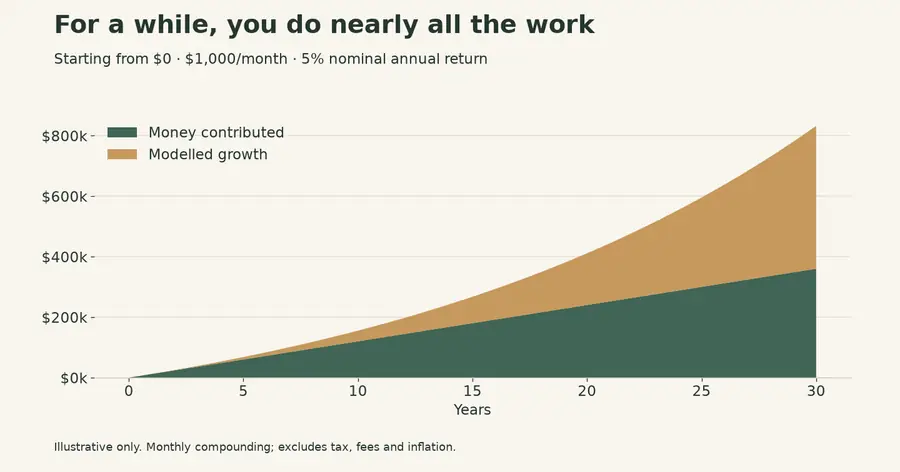
Suppose you start with nothing and invest $1,000 at the end of each month. We will assume a constant nominal annual rate of 5%, divided by 12 for monthly compounding. This is an illustration, not a return forecast, and it excludes fees, taxes and inflation. I am measuring an investment portfolio here, not total net worth, so home equity stays out of this calculation.
At the end of the first year, you have contributed $12,000. The model gives you roughly $12,279. Your investments have supplied about $279. Don’t spend it all at once.
After five years, you’ve contributed $60,000 and the balance is about $68,000. After ten years, the contributions total $120,000 and the balance is roughly $155,000. The investment growth has become large enough to take seriously, although your contributions are still doing most of the work.
The second $100,000 gets a head start
Here is the bit I enjoy. Keep the contribution and the assumed return exactly the same, then calculate how long it takes for the account to reach each additional $100,000. No promotion, inheritance or brilliant investment idea is required in this particular model.
| Milestone | Months since prior milestone | Years since start |
|---|---|---|
| $100,000 | 84 | 7.0 |
| $200,000 | 62 | 12.2 |
| $300,000 | 50 | 16.3 |
| $400,000 | 40 | 19.7 |
| $500,000 | 35 | 22.6 |
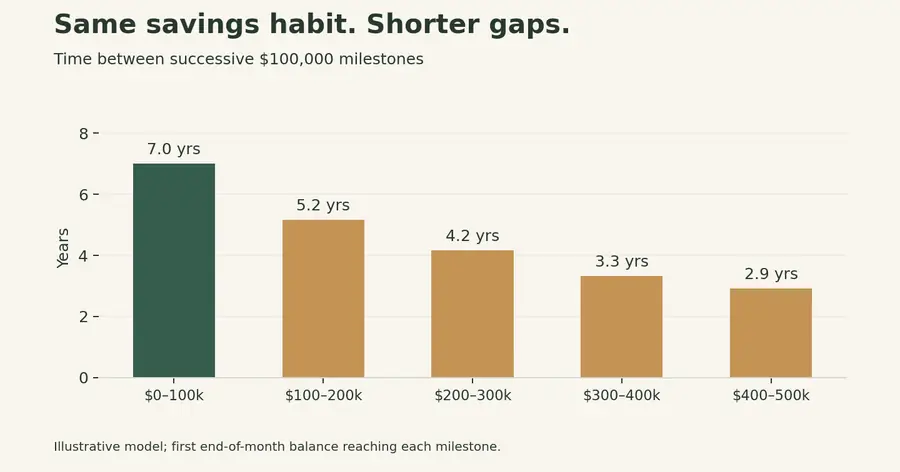
The first $100,000 needs the longest stretch of monthly contributions. By the time you reach $400,000, a 5% effective annual gain would be $20,000, compared with $12,000 of annual contributions. You are now in a rather different position from the person who was celebrating a $279 gain in year one.
For anyone who wants to reproduce the calculation, use monthly rate r = 0.05 ÷ 12 and n months. Starting from zero, the projected balance is $1,000 × ((1 + r)^n − 1) ÷ r. In Excel or Google Sheets, =FV(5%/12, n, -1000, 0, 0) gives the equivalent result. Use the first whole month for which the balance exceeds the target.
What if $1,000 a month is a bit optimistic?
Fair question. In many cities, $1,000 is a substantial amount of money to have left after rent, transport and the rather persistent habit of eating food.
At $500 a month, the same model takes about twelve years to reach the first $100,000. At $2,000 a month, it takes a little under four years. These are three different financial lives, not three levels of moral achievement. Without any investment growth, the $1,000-a-month saver would need 100 months, or eight years and four months.
If you earn $3,000 after tax, saving $1,000 is a different proposition from doing the same on $8,000. The more useful question is how much you can put aside regularly without creating a budget that collapses at the first dentist appointment.
A pay rise is one opportunity. If your take-home pay goes up $400 and you allocate $200 of that to long-term savings, you have improved the maths without cutting anything you currently enjoy. The other $200 can make life a little more pleasant. This is one reason I would spend at least as much energy thinking about earning power as comparing the fees of every investment product on the internet.
The market has no respect for round numbers
Imagine you finally reach $100,000 and the account drops 25%. Suddenly you’re at $75,000, and the milestone you had planned to celebrate has disappeared.
At that point, the portfolio needs a gain of 33.3% to recover without further contributions: $25,000 divided by $75,000. The return path matters. A smooth spreadsheet curve disguises what can be a fairly unpleasant experience in practice. That is also why the second $100,000 is not guaranteed to arrive faster than the first.
I would not treat $100,000 as a deadline that justifies taking risks I cannot afford. Keep money needed in the near term separate, and remember that an invested balance is not necessarily a suitable emergency fund. A more realistic plan might take longer but be easier to live with when the market misbehaves.
Make the early years less tedious
It is tempting to check the portfolio every morning. Unfortunately, refreshing a balance does not contribute to it. A monthly review is enough for the purpose of watching this particular milestone, and it gives you a chance to track how much of the change came from new savings rather than price movements.
I wouldn’t judge the first few years by the excitement of the investment returns. Judge them by whether you have built a habit that you can keep going through the rest of your working life. The boring bit is not a detour. It is where most of the foundations are laid.
Education only, not financial advice. This article is general information, not a recommendation to buy, sell or hold anything. Examples are illustrative. Check current rules for your country, and consider a licensed adviser for decisions about your own situation. Full disclaimer.