 The Modest Goose
I like the savings rate because it is wonderfully difficult to impress with a job title. A person retaining $1,200 out of $6,000 a month is saving 20%, regardless of whether they describe their career as exciting, prestigious or in urgent need of a holiday.
A good savings rate is one that funds the things you want later without making your life unnecessarily miserable now. There are a few wrinkles in the calculation, though. A bonus month, a mortgage payment and an expensive December can all make you think your finances are doing something they aren’t.
Work with the pay that actually arrives
For everyday budgeting, I like a take-home savings rate: money retained from after-tax cash income divided by that income. Retained money includes deposits to savings and investments, provided you do not count the same transfer twice. Withdrawals from savings reduce retained money. Define whether debt principal repayments count separately; they build equity but do not leave cash available.
If you include retirement deductions and employer contributions, calculate a broader gross-income measure instead. Add eligible contributions to both the relevant savings numerator and compensation denominator consistently. Do not compare a gross rate with somebody else’s after-tax rate as though they are identical.
A $6,000 month, with the boring bills included
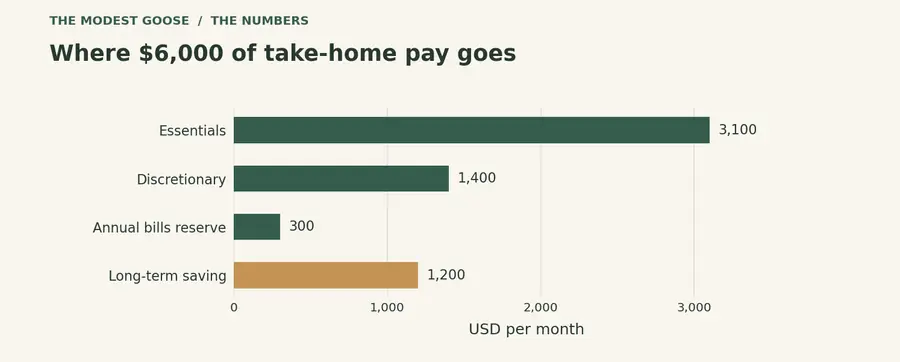
Say you take home $6,000 a month, spend $3,100 on essentials and $1,400 on discretionary purchases, and set aside $300 for annual bills.
Of that $6,000, the three spending buckets consume $3,100 + $1,400 + $300 = $4,800. That leaves $1,200 for long-term goals. Divide it by the take-home pay ($1,200 ÷ $6,000) and the savings rate is 20%.
Notice that the $300 set aside for annual bills doesn’t get counted as long-term saving. It may still be in the bank, but we already know it has a job. Otherwise the month before the insurance renewal will look remarkably virtuous and the month of the renewal will look like a financial calamity.
Now suppose a promotion adds $700 to take-home pay. Spending rises by $200. The new amount retained is $1,700 on $6,700 of income, or 25.4%. You have improved the savings rate without banning every enjoyable expense.
The $300 annual-bills allocation is treated as planned spending here, not long-term savings. If you prefer to count it as cash retained until the bill is paid, be consistent and recognise that it isn’t all available for other goals.
What rate would actually get you where you want?
Start with the purpose. If a deposit for a home requires $24,000 in two years and you have nothing set aside, the simple funding target is $1,000 a month before interest. Add retirement contributions, emergency reserves and other objectives separately. If that total is too high for your income, adjust the timeline, goal amount or spending plan rather than pretend the spreadsheet will fix the gap.
People often ask whether saving 10%, 20% or 50% is enough. Those numbers mean little without knowing income, time horizon and obligations. Saving half a modest income can involve real hardship; saving a smaller proportion of a substantial income may still fund considerable goals.
December is not a financial disaster
Housing, childcare, healthcare and changes in family support can all move the number. So can less dramatic things such as eating out a little more often after a promotion. A single expensive month may be perfectly sensible. Look at the rolling average over several months, and make sure irregular expenses are included.
An annual insurance bill should not surprise a budget twelve times in a row. Put aside a monthly amount for predictable costs so the plan reflects reality.
Make a little progress rather than an ambitious promise
Review the three largest recurring costs and the next expected increase in income. Decide in advance what portion of that increase will go towards your goals. You don’t need to audit every coffee to get started. The high-impact changes usually deserve more attention than the tiny ones.
The bonus-month illusion
Suppose you receive most of your variable compensation in February. Your savings rate for that month might look outstanding, while your ordinary monthly finances barely generate a surplus. That February number is technically accurate if you calculate it from actual cash received. It is not necessarily a useful guide to what you can afford in April.
I would track two views if a meaningful portion of income is variable. The first is your regular monthly rate, based on dependable cash income and the corresponding ordinary expenses. The second is the annual rate using all income actually received and all expenses incurred or consistently recorded during the year. This lets you see the strength of your recurring budget without ignoring the financial contribution of bonuses.
One useful distinction is between a bonus used to fund an unusual but planned expense and a bonus used to cover a recurring shortfall. Paying for a holiday from a bonus can be a perfectly reasonable choice. Relying on an uncertain bonus to make the ordinary mortgage payments work is a different arrangement altogether.
Why the bank balance can disagree
If you save $1,000 from your salary and transfer it to an investment account, your current account balance may hardly change. That doesn’t mean you saved nothing. Equally, an increase in your bank balance caused by selling some existing shares is not necessarily new saving. You have exchanged one asset for another.
For a cash-based savings rate, it helps to work through external income and expenses rather than simply subtracting last month’s bank balance from this month’s. Record transfers separately and make sure both sides of the transfer reconcile. If you have a pension deduction before take-home pay, decide whether to show it in a separate retirement savings measure or reconstruct a broader income definition.
Debt repayment deserves a similar treatment. Someone paying down a mortgage may increase home equity through the principal portion of the payment. Interest is a cost. You might therefore track financial wealth accumulation from debt reduction separately from cash retained for investments. That prevents a sensible debt repayment strategy from appearing worse simply because the cash left the bank.
Save more without hating your life
I would set an achievable initial target, observe it over a few ordinary months and then revisit it. Some spending is inconvenient but necessary; some makes your life genuinely better. A useful savings plan leaves room for both while reducing the spending you would not miss particularly much. You want a rate that continues when life gets busy, not one that looks spectacular on a carefully chosen month.
A savings rate is a useful scoreboard, not a personality test. If it is steadily funding the life you want and you still enjoy the life you have, I think that’s a better result than a spectacular number you abandon in February.
Education only, not financial advice. This article is general information, not a recommendation to buy, sell or hold anything. Examples are illustrative. Check current rules for your country, and consider a licensed adviser for decisions about your own situation. Full disclaimer.