 The Modest Goose
You don’t need a spectacular salary to become a millionaire. You do, however, need a fairly unglamorous combination of time, money left over at the end of the month and the ability to keep going when life gets expensive.
I find the phrase ‘normal salary’ rather funny. It means something entirely different depending on which city you live in, which friends you compare yourself with and whether you’ve looked at the cost of childcare recently. Instead of arguing about what counts as normal, let’s see what an ordinary monthly surplus can do.
Start with the money you actually keep
There is no useful international definition of a normal salary. A comfortable income in one city can look alarmingly inadequate in another. So let’s forget the job title and look at take-home income after the bills you can’t avoid.
Suppose a person takes home $4,000 a month and has average spending of $3,000, including provision for irregular bills. They can contribute $1,000 a month, a 25% share of take-home income. This is an illustrative household budget, not a claim about typical earnings.
What $1,000 a month can become
Assume the person starts at age 25 with zero invested, contributes at month-end and earns a hypothetical constant 5% nominal annual return compounded monthly. The table shows the model before fees, tax and inflation.
| Age | Total contributions | Modelled balance |
|---|---|---|
| 30 | 60,000 | 68,006 |
| 35 | 120,000 | 155,282 |
| 45 | 240,000 | 411,034 |
| 55 | 360,000 | 832,259 |
| 65 | 480,000 | 1,526,020 |
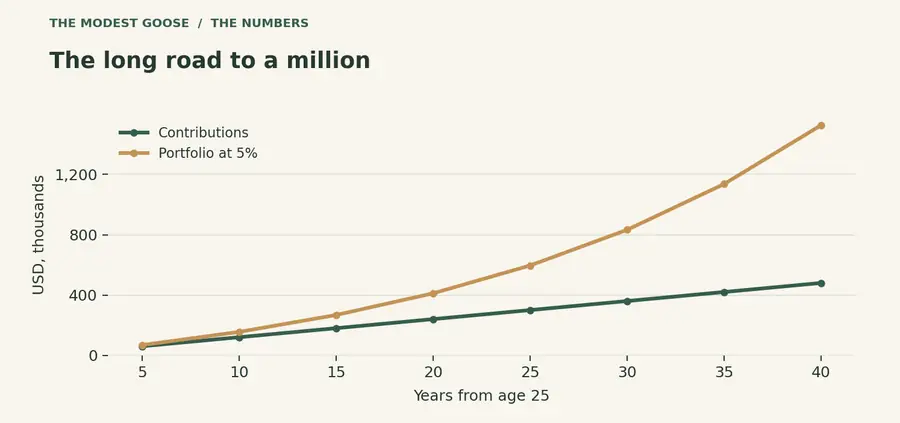
After forty years, you have put in $480,000 yourself. The hypothetical investment balance is about $1.53 million; roughly $1.05 million of it is growth. That’s a pleasing outcome on paper. It also assumes four decades of uninterrupted monthly contributions and a constant return, which is not how either life or markets normally behave.
Let a promotion improve your life, too
A person who starts by saving $500 a month does not have to remain at that level forever. Imagine receiving a $300 monthly increase in take-home pay. Allocating $150 to additional saving leaves the other $150 available for improved living standards. This avoids the rather miserable idea that every promotion should make absolutely no difference to your life.
I like making that decision before the raise starts arriving. It’s much easier to allocate $150 that has never appeared in your account than to remove a $150 monthly expense you have come to regard as a basic human right.
A million dollars is not a retirement plan
Not necessarily. A million mostly made up of home equity is different from a million you can draw from. If you spend $80,000 a year, $1 million of accessible financial assets equals 12.5 years of spending before returns and taxes; at $30,000, it is 33.3 years. Neither figure is a safe retirement period, but it’s a better place to begin than the round number alone.
Inflation matters as well. At a hypothetical 2.5% annual inflation rate, $1 million received in forty years would have purchasing power of roughly $372,000 in today’s dollars. A target should evolve with the cost of the life you intend to fund.
What if the maths doesn’t work?
Try a lower-return case and a period without contributions. If the target only works when income rises continuously and investments deliver a high return every year, the spreadsheet is giving you a warning. Consider a longer horizon, different spending assumptions or a smaller target matched to your actual goals.
I would not sacrifice emergency savings simply to make the millionaire calculation look better. Keep the funds for near-term obligations separate and review progress annually.
The million-dollar figure is a useful destination for an experiment. The rather less glamorous job is finding a contribution you can keep making without turning the next thirty years into a punishment.
Education only, not financial advice. This article is general information, not a recommendation to buy, sell or hold anything. Examples are illustrative. Check current rules for your country, and consider a licensed adviser for decisions about your own situation. Full disclaimer.