 The Modest Goose
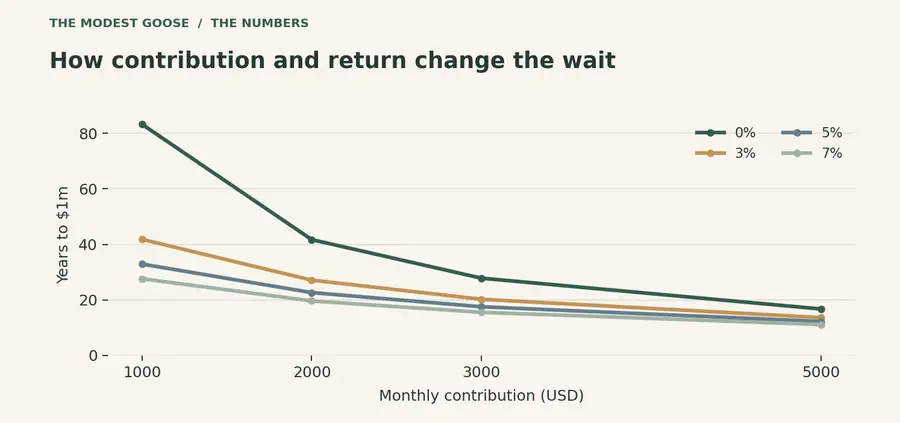
At $1,000 a month and no investment growth, saving a million dollars takes 83 years and four months. I admire the determination of anyone willing to wait that long, although I suspect a few of us would prefer a slightly earlier appointment.
Investment growth, a higher contribution or an existing balance can change the answer considerably. Let’s put some dates against those possibilities rather than just repeat the familiar instruction to save early and often.
The millionaire timetable
| Monthly amount | 0% return | 3% return | 5% return | 7% return |
|---|---|---|---|---|
| $1,000 | 83.3 yrs | 41.8 yrs | 32.9 yrs | 27.6 yrs |
| $2,000 | 41.7 yrs | 27.1 yrs | 22.6 yrs | 19.6 yrs |
| $3,000 | 27.8 yrs | 20.2 yrs | 17.5 yrs | 15.5 yrs |
| $5,000 | 16.7 yrs | 13.6 yrs | 12.2 yrs | 11.1 yrs |
These aren’t return forecasts. Start from zero, add the same amount at the end of every month and apply a constant nominal annual return divided by twelve. The times are rounded up to whole months, then shown in years. Fees, taxes and inflation are excluded. The markets will not follow this timetable simply because we have taken the trouble to draw it.
If you want to reproduce the model, let B be the opening balance, P the monthly contribution, r the monthly rate and n the number of months. The projected balance is B(1+r)^n + P[(1+r)^n − 1]/r. At zero growth it is simply B + Pn.
Starting with $100,000 changes the race
Consider someone starting with $100,000 rather than zero. They contribute $2,000 each month. At zero growth they need another $900,000, equivalent to 450 months or 37.5 years. With a constant 5% nominal return, the calculation changes because the existing capital also grows. The existing balance can have a substantial effect on the timeline.
The important detail is whether that opening $100,000 is available for the modelled goal. A home deposit due in six months is not necessarily an appropriate starting investment balance, even if it appears in your total net worth.
Two percentage points over several decades
Two percentage points of return can look almost irrelevant in year one. Over decades they make an enormous difference. I’d rather see the modest-return case alongside the optimistic one than select the assumption which conveniently gets me to a million just before my fortieth birthday.
For a useful plan, compare a zero-growth case, a modest-growth case and a more favourable case. Revisit the calculation each year using the actual starting balance. The future date is allowed to change.
Life occasionally interrupts the spreadsheet
Say you normally contribute $2,000 a month and take a twelve-month career break. Your contribution shortfall is $24,000. If the money would otherwise have been invested for many more years, the eventual shortfall could be larger because of foregone growth. But a career break may also be valuable for reasons the spreadsheet cannot capture.
I would put the break explicitly in the plan rather than pretend every year is identical. Model the cash needed during the break separately from long-term investments. A reliable plan should reflect the life you expect to live, including inconvenient periods in which you do not add to the balance.
Does it need to be a million?
Also, a million dollars is not a fixed amount of purchasing power. At an assumed 2% annual inflation rate, prices would be roughly 81% higher after thirty years. You would need about $1.81 million then to buy what $1 million buys today. The spreadsheet can keep the round-number milestone; the plan needs to recognise what that money will actually buy.
Work backwards from spending needs and desired flexibility. If a smaller balance achieves the goal, there is no special benefit to waiting for an extra zero. If the desired lifestyle costs more, a million may simply be an intermediate step.
Your own contribution history is more useful for updating a forecast than the most optimistic row in a table.
The date on the spreadsheet is not a deadline you have failed if markets don’t cooperate. It’s a moving estimate. Update it with what actually happened and decide whether the life you’re funding still needs the same amount.
Education only, not financial advice. This article is general information, not a recommendation to buy, sell or hold anything. Examples are illustrative. Check current rules for your country, and consider a licensed adviser for decisions about your own situation. Full disclaimer.