 The Modest Goose
How to Stop Being Busy Without Being Productive
It is quite possible to spend an entire Saturday preparing to do something. By dinner you have researched the tools, organised your notes and perhaps created a particularly tasteful spreadsheet. The actual thing you wanted to make remains unmade.
I wouldn’t dismiss preparation; sometimes it saves a great deal of work. But activity and progress are not quite the same thing. If a week feels relentlessly busy, I would look at what it produced before looking for ways to make it even busier.
The distinction that matters
Activity is an action: attending a meeting, reading an article or reorganising a document. An outcome is the change you wanted to achieve: reaching a decision, solving a problem or delivering something useful. Activity can support an outcome, but the connection is not automatic.
For example, someone trying to change jobs could spend a week redesigning their application tracker without contacting a single employer. The tracker may look better. The job search itself has not necessarily advanced.
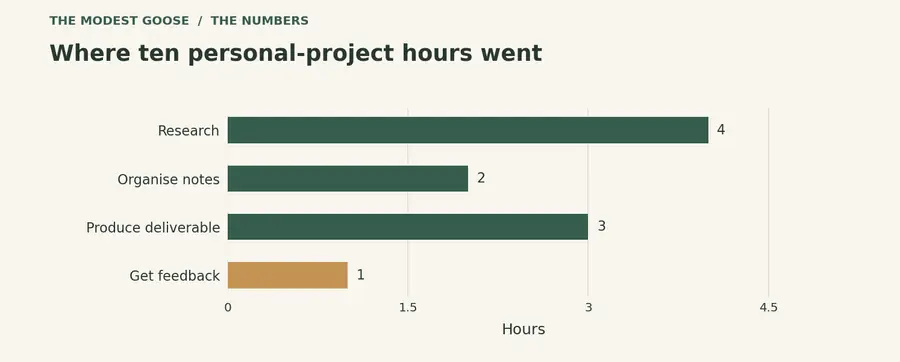
What happened to those ten hours?
Suppose you spend ten discretionary hours on a personal project. Four hours go into researching tools, two into reorganising notes, three into producing the actual deliverable and one into obtaining feedback.
Research and organisation used six hours out of ten. Producing something and getting feedback used four. If two hours of research and one of organisation turn out to be sufficient next week, we reclaim three hours.
I might put those hours towards producing the thing, finding someone to look at it or taking the rest of the evening off. The aim isn’t to eliminate research. It’s to stop treating research as an unlimited activity that can always justify another hour.
Do not conclude that research is useless. Some projects require substantial preparation. Ask whether the preparation still changes a decision or whether it has become a comfortable substitute for doing something uncertain.
Make something small enough to finish
At the beginning of the week, write down one or two outcomes that would make the week worthwhile. Give each an observable definition of done. Instead of ‘work on website’, try ‘publish the revised product page and test the checkout’. Then schedule the tasks most likely to achieve that outcome.
After the week, look at what changed. If you completed many tasks but did not reach the outcome, identify the constraint. Perhaps you need information from someone else or the target was unrealistic. More activity is not always the solution.
Not everything in life is a project
Not everything needs to produce an outcome that can be put in a report. Cooking dinner, taking a walk or catching up with a friend can be worthwhile without measurable productivity gains. Use the framework for activities where you actually want progress, not as a way to judge every hour.
I would prefer a short list of useful commitments and enough room to enjoy the rest of the week over an impeccably organised calendar that leaves no room for either.
What counts as a useful result?
Start with the reason you have agreed to do the work. If you are preparing for a job interview, the useful outcome is being able to demonstrate relevant experience and understand the role. That may require research and practice, but it does not necessarily require a beautifully formatted twenty-page document. If you are organising a household move, the useful outcome is completing the necessary arrangements by the relevant dates. A long list of interesting properties may be useful for a while, but at some point the work needs to lead to a decision.
I would look at the activities that are closest to producing the desired outcome. Which action would resolve an important uncertainty? Which would complete a deliverable or unblock the next step? If the answer is unclear, some research may be appropriate. Once the uncertainty has been resolved, continuing the same research is less likely to be useful.
There is an important distinction between doing something that is uncomfortable and doing something that is unimportant. The action that advances a project may be the one you least enjoy, such as asking someone for feedback or confronting a difficult financial decision. It can be tempting to substitute a more pleasant administrative task. Recognising that pattern helps you decide whether the alternative activity genuinely deserves the time.
Planning should be a small part of the work
Planning is useful when it prevents confusion or wasted effort. It becomes less useful when you spend a disproportionate amount of time organising work that could already have been completed. For a relatively simple action, a clear description and a suitable time may be all the planning required. A large or expensive project may justify considerably more preparation.
I would match the effort spent on planning to the consequences of getting the decision wrong. Comparing several alternatives before making a significant purchase may be worthwhile. Spending half an hour choosing the order in which to answer three routine emails probably is not. The difference is not that planning is inherently good or bad. It is whether the next bit of planning is likely to change what you do.
When the obligations aren’t optional
Not everybody has control over their working hours or household responsibilities. Some jobs involve frequent interruptions and a need to respond to other people. Some personal circumstances involve a great deal of necessary work that does not produce a conveniently measurable outcome. Advice to simply eliminate everything that is not directly productive can be rather unhelpful in those situations.
Look for a manageable change within the actual constraints. Can related administrative actions be done together? Is there a short period when uninterrupted work is more practical? Could a recurring decision be made once rather than reconsidered every day? If none of those options fits, it may be more useful to reduce the number of additional projects you are attempting to maintain.
Remember that necessary care, maintenance and everyday responsibilities are worthwhile even when they cannot be described as dramatic progress. A well-run household requires plenty of ordinary work. The framework is intended to help you allocate discretionary effort more consciously, not dismiss the obligations that keep your life functioning.
I would rather finish a useful thing and have a free evening than optimise myself into a person who is always preparing to finish useful things. There is no prize for maximum utilisation of your Saturday.
General information. This article shares ideas and examples for organising work and life. It is not professional advice. Full disclaimer.