 The Modest Goose
Starting a side business while keeping a day job is a sensible arrangement. The day job pays the bills; the business gets an opportunity to work without immediately having to pay the bills. The difficulty is that both would quite like access to the same evenings.
I’d start with a real weekly time budget and one question about the business: what evidence would make me want to spend another month on it? Six good hours of testing a product or talking to customers can be far more valuable than twelve hours of making the website prettier.
How many hours are really available?
Start with a normal week, not an unusually quiet one. Subtract work and commuting, sleep, meals, care responsibilities, household tasks and time you want to preserve for yourself. The remaining hours are potential capacity, not a requirement to fill them.
Check your employer’s policies and contract before undertaking outside work. Conflicts of interest, intellectual property and confidentiality obligations matter. Keep personal business files, accounts and devices separate where required, and do not use employer resources without permission.
The work that gets you closer to a customer
Prioritise the activity that tests whether the side business is worth continuing. For a service business, that might be conversations with prospective customers or completing paid work. For a digital product, it could be shipping a useful product, obtaining feedback or improving the page where visitors decide whether to buy. Changing colours on a website for the fourth time is unlikely to be the most urgent task unless the page is genuinely unusable.
Keep a simple project list and distinguish activities that create evidence from those that merely feel productive. Research is useful when it changes a decision. Administration is necessary, but it should not consume the whole week.
A six-hour week that leaves you a life
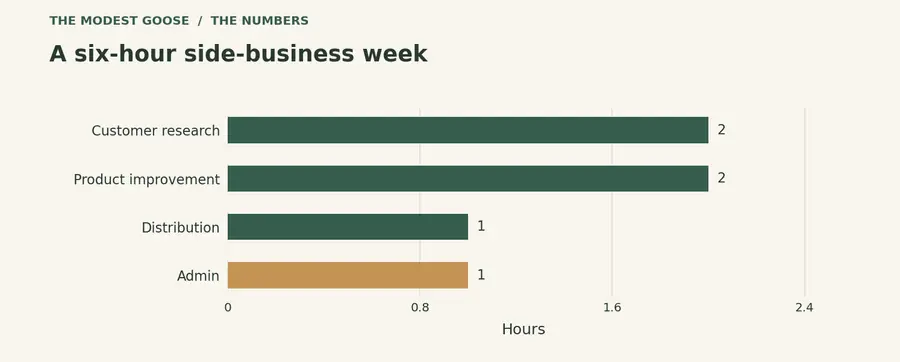
Suppose a person can comfortably allocate six hours a week after other commitments. They plan two hours on customer research, two on product improvement, one on distribution and one on admin.
Two hours of customer research, two improving the product, one on distribution and one on administration add up to six hours. That’s 24 hours in four normal weeks.
During a week when work gets busy, suppose only three hours are available. I’d protect the activity most likely to teach me whether there is demand and move the rest. It is a business experiment, not a debt of time you have to repay by sacrificing next Sunday’s sleep.
Suppose one month brings $300 of collected revenue and $80 of business costs. The resulting $220 surplus before tax divided by 24 hours is about $9.17 per hour. Early businesses often require upfront work, so this is not a verdict on the idea. It is useful evidence alongside customer interest and progress.
Deciding whether the experiment is working
Review monthly. Look at money collected, costs, time spent, customer feedback and the next realistic experiment. Set a limit on the effort or budget you are comfortable risking before seeing stronger evidence. Be prepared to pause a project if your main job or personal life becomes unusually demanding.
Choose something that fits your circumstances
I would examine how the work fits the hours that are actually available. If your only reliable time is a couple of evenings a week, a business that routinely requires calls during the working day may be a poor fit even if the revenue opportunity appears attractive. If you travel frequently or have unpredictable work commitments, a rigid publishing or delivery schedule might be difficult to maintain.
Consider the minimum version of the business that can be tested responsibly. You do not need to build every proposed product before establishing whether prospective customers have a problem worth solving. Start with an offer or experiment that has a clear purpose, a manageable budget and a practical way to obtain feedback. Be honest about what you can deliver alongside your existing obligations.
Revenue isn’t your personal spending money
Collected revenue is not the same as personal income. The business may have payment processing costs, software subscriptions, refunds, professional fees, tax obligations and other expenses. Some revenue may need to remain in the business to deliver services already sold. Before treating a side hustle as a reliable contribution to the household budget, understand what remains after these obligations.
I would keep a simple record of revenue received, direct costs, recurring overheads and money that needs to be reserved for future liabilities. Use the appropriate legal and tax treatment for your jurisdiction and business structure. A separate business account or bookkeeping arrangement may help distinguish transactions, depending on the circumstances. Do not assume every amount paid into the business can immediately be transferred to your personal spending account.
It is also useful to track how much time the business consumes. A project may eventually produce a good return, but the early results need to be interpreted in the context of development effort. The purpose of tracking hours is not to insist that every early activity immediately earns a competitive hourly rate. It is to understand whether the workload and financial prospects are moving in a direction you are comfortable with.
When the day job needs more attention
A sensible side-business schedule should have a lower-capacity version. Identify the commitments that must be maintained, such as work already promised to customers, and the activities that can be reduced temporarily. If your employer has an unusually demanding period, you may need to pause new projects or reduce the frequency of optional marketing work. Make that decision before the week becomes impossible.
For example, if a normal schedule includes product development, marketing, customer support and research, the reduced schedule might retain support and one important product improvement. The rest can be moved to a later date. Communicate changes to customers where appropriate rather than continue promising a delivery timetable that no longer fits.
Finally, make an explicit decision about the personal time you do not intend to use for work. Starting a business is a voluntary commitment, and there is no obligation to make every spare hour available to it. If the only way the plan works is by indefinitely reducing sleep, neglecting important relationships or allowing your main job to deteriorate, the plan probably needs to become smaller. The aim is to create more options over time, not to exchange one demanding job for two.
Keep business assets and obligations clearly separate from personal cash.
A side business should have a chance to become a good business, not a standing invitation to exhaust yourself. Protect the income that funds the experiment and let the evidence determine when it deserves more of your life.
Education only, not financial advice. This article is general information, not a recommendation to buy, sell or hold anything. Examples are illustrative. Check current rules for your country, and consider a licensed adviser for decisions about your own situation. Full disclaimer.