 The Modest Goose
How to Prioritise Tasks When Everything Feels Urgent
If everything on your task list is marked urgent, the word has ceased to be useful. It has become a colour scheme.
The problem isn’t always that you need to work faster. Often it’s that the deadline, the consequences of missing it and the amount of work involved haven’t been considered together. I would decide what really needs doing tonight before letting the whole list take over the evening.
Urgency and importance aren’t twins
An urgent task has a meaningful time constraint. An important task contributes to a meaningful outcome or prevents a significant problem. The two can overlap, but they are not interchangeable. A genuine payment deadline is both; a notification about a minor update may feel urgent without having much consequence.
I would also look at dependencies. If a ten-minute email unblocks someone else’s work for the day, it may be worth doing before a longer task. The impact of a task is not always proportional to the time you spend on it.
Ninety minutes on a Wednesday evening
Use four questions: Is there a real deadline? What happens if it waits? Does it unblock something important? How much uninterrupted time does it need? Record the answers where the distinction is unclear. You do not need a complicated numerical ranking system for every routine task.
Suppose it is Wednesday evening and you have 90 minutes free. You need to submit a form due tomorrow (25 minutes), reply to a collaborator waiting to proceed (10), prepare for a Monday meeting (60), renew a subscription next month (10) and organise your files (45).
Start with the form due tomorrow (25 minutes) and the reply that allows someone else to proceed (10). That leaves 55 minutes. Set aside five for transitions and use 50 for a useful chunk of Monday’s preparation.
There are ten minutes of meeting preparation remaining, and other items still on the list. Give them a home in the calendar rather than spending the next ten minutes staring at a red dashboard telling you that you’re behind.
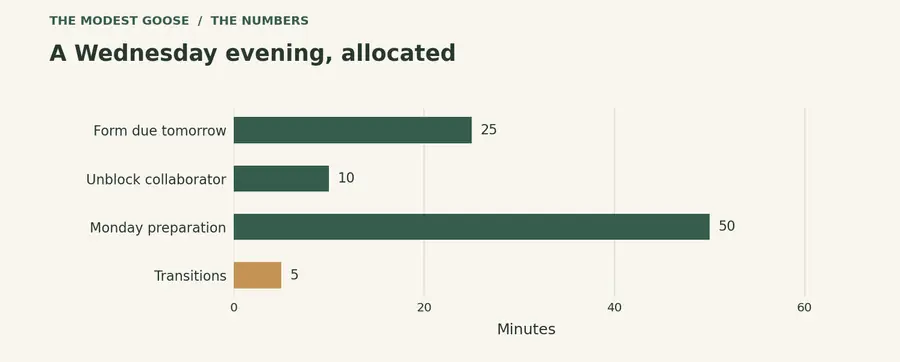
The subscription and file organisation can stay in the backlog. The plan covers 85 minutes of task effort rather than pretending 150 minutes of work fits into a 90-minute window.
When the deadlines really do collide
Look at whether commitments can be renegotiated, delegated, reduced in scope or scheduled differently. Sometimes the issue is capacity, not prioritisation. Working faster will not solve a permanent mismatch between available hours and obligations.
If someone adds a new task, ask what can move. At home, the same principle applies. You cannot automatically insert a new two-hour commitment into a full Saturday without giving something else up. It is perfectly reasonable to prefer some downtime over reorganising a cupboard.
Make the priorities visible
Keep priorities simple. I like three categories: must do within the available window, schedule for later, and reconsider. Combine them with due dates and time estimates. Review waiting tasks separately so you do not repeatedly try to complete something that depends on another person.
Some deadlines are merely preferences
I would distinguish three types of dates in a task list. An external deadline is a commitment with a meaningful consequence if it is missed. A planned completion date is when you intend to finish something, perhaps to leave time before the external deadline. An aspirational date is a preference, such as hoping to sort out the spare room this weekend.
All three can be useful, but they should not be treated as equally inflexible. If you assign tomorrow as the due date for every task you would quite like to finish, the tracker will start telling you that everything is overdue. Eventually, you may stop taking its warnings seriously, including the ones that matter.
For work with a genuine external deadline, allow time for review and possible delays. For other work, use a planned date only if you have a realistic idea of when you can do it. An undated optional task is not necessarily poorly managed. It may simply be waiting for an appropriate time or a decision about whether it needs doing at all.
Protect important work before it becomes urgent
These are often the commitments that make a difference over a longer period. Learning a skill, maintaining financial records, preparing for a career transition or organising a major purchase may not have somebody reminding you every morning. Without dedicated time, they can remain indefinitely behind smaller requests that happen to arrive more recently.
I would allocate a modest amount of recurring time to one or two longer-term priorities. If you want to finish a course, for example, reserve a suitable session each week instead of assuming you will find time after everything urgent has been dealt with. This does not mean ignoring real deadlines. It means recognising that the stream of small obligations is unlikely to disappear completely.
Break important work into actions that fit the available sessions. ‘Prepare for a career move’ could easily occupy an entire weekend without producing a clear result. ‘Update the first two sections of the CV’ or ‘identify five relevant roles’ is a more practical task. You can still retain the larger objective in the project summary so the individual actions do not lose their purpose.
Three useful labels are plenty
Finally, leave a little room for unexpected commitments. A plan that uses every available minute may look efficient on paper, but it gives you no ability to respond when something changes. The purpose of prioritisation is not to create a perfect ordering of every possible task. It is to make the next meaningful decision with the time and information you have. If the list is still impossible after prioritising it, the next decision may be to remove something rather than organise it more carefully.
A basic table using the criteria above is enough to start.
The best outcome isn’t a beautifully ranked list of 27 tasks. It is an evening spent on the right things, with a reasonable plan for the rest and preferably a little time left to be a person.
General information. This article shares ideas and examples for organising work and life. It is not professional advice. Full disclaimer.