 The Modest Goose
A $30,000 pay rise is very easy to understand. The extra 13 hours a week that might come with it are usually written in rather smaller print, if they’re written down at all.
When comparing jobs, I would look at three numbers: the money you can actually use, the time you have to give up and the longer-term prospects. A bigger salary can be the better decision. But it should win a fair comparison, not simply turn up with the biggest number on the offer letter.
Put the offers on the same basis
Start with guaranteed annual compensation, then add reasonable scenarios for discretionary bonuses and equity. Do not count the largest possible bonus as guaranteed. Include retirement contributions, health coverage, leave and other meaningful benefits separately. Estimate after-tax cash pay using the appropriate jurisdiction and subtract additional commuting, childcare or relocation costs.
Finally, estimate the time required: typical hours, commute and unavoidable work outside normal hours. Ask the prospective team about a normal week, not just the contractual one.
When a $30,000 raise lowers your hourly pay
Suppose Job A pays $100,000 gross; Job B pays $130,000. Assume after-tax pay of $78,000 and $96,000, respectively, and 48 working weeks. These are hypothetical, not tax estimates.
Job A requires 42 hours including travel each week, with $2,000 annual work-related costs. Job B requires 55 hours and $6,000 in costs.
After work-related costs the two usable salaries are $76,000 and $90,000. Spread those amounts over 2,016 and 2,640 hours of annual work and travel respectively. The hourly figures are about $37.70 for A and $34.09 for B.
In other words, Job B offers $14,000 more usable income and requires 624 additional hours a year. That’s $22.44 for each extra committed hour. You might still take the offer, but at least you now know the price at which you’re selling that time.
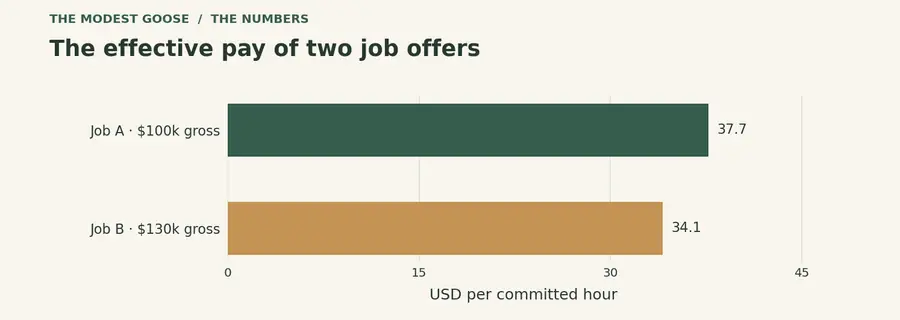
Job B still provides $14,000 more usable annual income. However, it requires 624 extra hours, so the incremental cash compensation is about $22.44 per additional hour. Whether that is appealing depends on what those hours would otherwise be used for.
What could the next job lead to?
Model three years of compensation rather than only the first year. Compare likely promotion opportunities, skills, industry demand and risk of job loss. A job that offers a smaller salary today might open up substantially better options later. Equally, a prestigious title without meaningful responsibilities may be less useful than it sounds.
Do not invent probabilities just to make a model look sophisticated. Start with a central case, a lower outcome and a stronger outcome. Then note the conditions under which each might occur. If you are comparing equity-heavy offers, model both a falling share price and forfeited unvested awards.
The trade I would make explicit
Write down the minimum cash income your household needs, the maximum time commitment you can realistically sustain, and the skills or responsibilities you want to gain. Eliminate offers that fail a non-negotiable constraint before ranking the remaining ones.
I would also give extra attention to what happens if the move does not work. A signing bonus might have repayment conditions, a relocation might be expensive to reverse, and a probation period could change your risk. Check the contract and maintain a realistic cash buffer.
Read the whole compensation package
A signing bonus should be shown as a one-off receipt rather than a permanent salary increase. Check whether the contract requires repayment if you leave within a certain period. An equity award should be spread across the actual vesting schedule, not treated as though the entire amount arrives in the first year. And a discretionary bonus should have a zero or lower scenario as well as the advertised target.
Benefits deserve their own comparison because a change of employer may transfer costs to you. If the new company offers less generous health coverage or a smaller retirement contribution, estimate the actual household impact rather than ignoring the difference. Where benefits cannot reasonably be valued in cash, describe them separately. It is better to acknowledge uncertainty than invent a dollar value for the convenience of a calculation.
How much of the raise survives?
The most useful number for immediate affordability is the amount of additional cash left after tax and additional costs. Use a payroll calculator appropriate to your jurisdiction or ask for a realistic pay estimate. A gross increase can push part of your income into a different tax bracket, but that does not mean the entire salary will necessarily be taxed at that higher rate.
Consider the practical changes that accompany the role. A new office might be farther away, require additional childcare or make it harder to prepare meals at home. You might receive a larger housing allowance but need to move somewhere more expensive. These effects can be substantial, even though none is visible in the headline salary figure.
The same applies to time. If the commute increases by 30 minutes each way, that is five additional hours over a five-day working week before any change in actual working hours. You could decide that the role is worth that commitment, but it helps to make the choice consciously. Comparing the incremental compensation per additional hour is one way to put the trade-off into perspective.
Questions I would ask before signing
These questions are more valuable than treating every future promotion mentioned during an interview as certain. Speak to people doing similar work where appropriate, and make sure contractual commitments are distinguished from expectations. Do not assume that a company will necessarily provide the same compensation trajectory as its most successful employee.
Finally, give yourself a little room for error in the transition plan. The first few months in a new job may involve travel, unfamiliar responsibilities or a longer adjustment period than expected. A financial model can help you compare alternatives, but it cannot predict what working there will feel like. If two options have reasonably similar financial outcomes, the quality of your day-to-day working life may deserve more weight than another small improvement in the numbers.
Sometimes taking the tougher job makes sense because it opens a door. Sometimes it simply leaves you too tired to enjoy the additional money. I would want to know which one I’m accepting.
Education only, not financial advice. This article is general information, not a recommendation to buy, sell or hold anything. Examples are illustrative. Check current rules for your country, and consider a licensed adviser for decisions about your own situation. Full disclaimer.