 The Modest Goose
A person earning $100,000 a year for another 25 years could receive $2.5 million in gross pay before any raises. Yet that same person might spend a whole weekend investigating a $2,000 investment and ten minutes deciding whether to accept a job.
I think we sometimes pay remarkably little attention to the asset responsible for buying all our other assets. The ability to earn an income has a financial value, even though you can’t transfer it to a brokerage account or sell it on Tuesday. Economists call this human capital.
What are future paycheques worth today?
Would you prefer $100,000 today or $100,000 a decade from now? Assuming you have a choice, most of us would find a use for the earlier payment. A discount rate is a modelling assumption that reflects time and, where appropriate, risk. Discounted cash flow (DCF) simply translates the later payments into today’s dollars and adds them up.
Your career is not a guaranteed bond. It could involve job losses, periods of study, promotions, career changes or a shorter working life than planned. Treat the estimate as a scenario, not a valuation anyone would pay you.
A $100,000 salary is bigger than it looks
Assume $100,000 of annual gross earnings, paid at year-end for 25 years, no raises and a 5% annual discount rate. Ignore taxes and benefits for this calculation.
The first $100,000, due in a year, is worth $100,000 ÷ 1.05 = $95,238 today under our assumption. The second year’s pay is worth $100,000 ÷ 1.05² = $90,703. The payments get progressively smaller when translated into today’s money.
Add the 25 discounted payments, using $100,000 × (1 − 1.05^−25) ÷ 0.05, and we get about $1.41 million. Not quite the $2.5 million you would collect in nominal terms, but a sum that deserves rather more attention than a small fluctuation in the stock market.
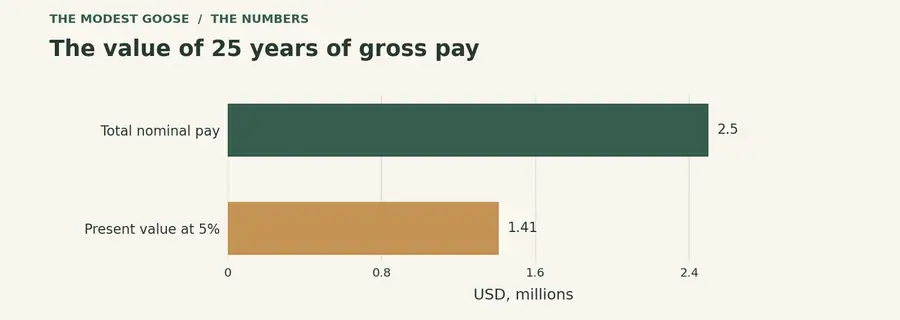
An extra $10,000 a year under the same assumptions adds approximately $141,000 in present value. A $10,000 raise sounds nice. The accumulated difference over a career sounds rather more consequential.
This is gross earning potential, not future savings. You still have to pay taxes and live somewhere. To model investable cash, substitute expected after-tax surplus for gross pay. Keep those two models separate.
The career decisions that deserve a spreadsheet
A qualification that improves your earning power, a move to a growing field or the chance to work with a better manager could affect a great many future paydays. That is worth comparing alongside the immediate salary. It is also why I’d be rather wary of making a career decision to free up a few thousand dollars for investing while overlooking its effect on the next ten years of income.
The calculation also puts a number around career risk. If your company supplies both your salary and a significant part of your investment portfolio, you are depending on the same organisation twice. And if you have a high income but little cash, the theoretical value of your career will not pay this month’s mortgage if that income stops.
Don’t put too much faith in a straight line
Put the career on three lines rather than one: an interrupted or slower-growth case, a reasonable central case and an optimistic case. Keep the assumptions visible. A promotion you have not been offered belongs in the scenario, not in the money you have already earned.
Then make a second list that contains things the calculation cannot capture. Health, family time, job satisfaction, geographical flexibility and how much control you have over your work are not minor rounding errors. A lower financial valuation can accompany a far better life.
I would use the number to help ask better questions about a job, not to decide that every waking hour must be monetised.
A career isn’t a bank account
Please don’t take the seven-figure career estimate to the mortgage lender and expect them to count it as a deposit. Future earnings are conditional on work, health, employment and circumstances. They are not a financial asset in the way your savings are. Keep the estimate separate from your balance sheet.
The assumptions that really move the answer
The number of years worked, expected compensation and discount rate will all affect the estimate. Compensation can be broken into dependable salary, variable bonuses and employer contributions or benefits. The treatment of tax should be consistent throughout the model. If earnings are expressed in today’s purchasing power, use a compatible real discount rate; if they include nominal wage growth, a nominal rate is appropriate.
It is worth considering the cost of acquiring additional earning power. A qualification may involve tuition fees and a period of reduced income. Relocation might raise compensation and housing costs simultaneously. A promotion may make it harder to maintain other activities you value. The increase in salary is only one part of the change.
Would a course pay for itself?
Suppose a qualification costs $4,000 and requires 100 hours of study. You believe it could help you move into a more rewarding role, but there is no guaranteed salary increase. You might compare a scenario with no earnings improvement against one with a modest raise and one with a significant progression. The cost occurs regardless of which outcome is realised, while the benefit is uncertain.
Before assigning numbers, I would try to obtain evidence: do job listings for the roles you want ask for this qualification? Do people currently doing the work find it useful? Is the skill transferable to another employer? These questions can improve the assumptions more than adjusting a discount rate by a decimal point.
There is another consideration that tends to disappear in financial models. The work itself might be interesting, meaningful or simply a better fit for how you want to spend your days. Those benefits can justify a decision even if the projected earnings improvement is modest. A career valuation is a useful perspective, but it is not a comprehensive measure of someone’s working life.
If a decision could change the next ten years of your income, it deserves more thought than the next ten days of your portfolio. That’s not an argument for chasing the highest salary at every opportunity. It’s an argument for noticing how much the decision is worth.
Education only, not financial advice. This article is general information, not a recommendation to buy, sell or hold anything. Examples are illustrative. Check current rules for your country, and consider a licensed adviser for decisions about your own situation. Full disclaimer.