 The Modest Goose
A pay cut has the unfortunate distinction of being something your bank account notices immediately and your career may take years to thank you for. That doesn’t make it a bad decision. It makes it a decision worth putting some numbers around.
I would start by finding the actual monthly shortfall, not the difference between the two salaries on a website. Then I would ask what the lower-paying job is buying: a better path, fewer hours, a shorter commute or simply a life that feels a little more manageable.
The cost that will show up in your bank account
Compare after-tax pay, benefits, retirement contributions and expenses associated with each job. Calculate the difference in money available for household spending and saving. A cut in gross salary is not the same as a cut in take-home pay. Commuting and childcare costs may also change.
Suppose your current annual take-home pay is $84,000; a new role offers $72,000 after deductions. The current job costs $5,000 a year in commuting and related expenses, while the new one costs $1,000.
After subtracting work-related costs, the old job leaves $79,000 and the new one leaves $71,000. So the difference isn’t the $12,000 in take-home pay; it’s $8,000 a year, or around $667 a month.
That’s the amount the new job needs to fit into your budget. If it saves you a long commute and gives you evenings back, the $667 may be buying something quite valuable. If the role is otherwise the same, it’s a rather expensive change of scenery.
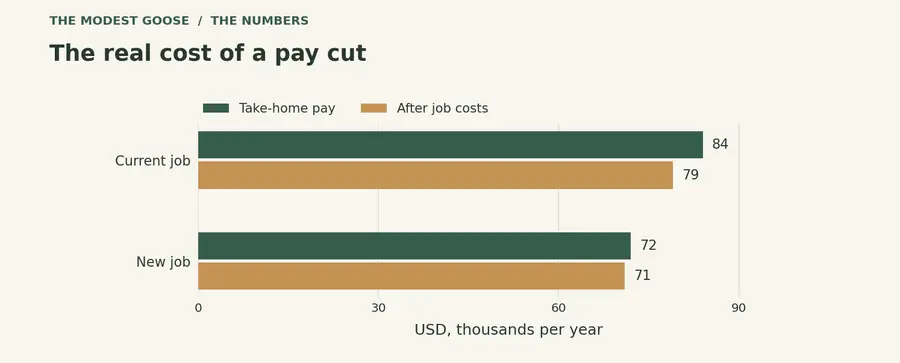
With annual household spending of $60,000, the current role leaves $19,000 and the new one leaves $11,000 before other savings adjustments. That is an important difference, but not necessarily a financially impossible one.
When a smaller salary may eventually win
Suppose the current role stays at $79,000 usable annual pay for three years. The new role starts at $71,000 but could rise to $78,000 and then $90,000. Ignoring time value, the old path produces $237,000 and the new path $239,000. Under a less favourable scenario in which the new income stays at $71,000, it produces $213,000 instead.
These assumptions are deliberately invented. The point is to identify what has to happen for the decision to work. A vague promise of future growth does not belong in a guaranteed-income column.
Buy yourself some room before accepting
Build a cash-flow forecast based on the new guaranteed salary. Include tax, regular bills, contractual debt payments, insurance, known annual expenses and a reserve for the transition. Test an interruption in income if probation, relocation or industry uncertainty matters.
Next, consider how reversible the choice is. Will you develop transferable skills? Could you return to similar work later? Would you need to move or give up important benefits? A salary reduction that buys genuine future options is different from one that closes doors.
I would also make room for non-financial reasons. The calculation does not have to prove that every family evening or improvement in health has a dollar price. It does need to show what the household is giving up and whether that trade-off is sustainable.
Other costs that change with the job
A pay cut rarely consists of a single change in a salary column. The new employer may offer different benefits, retirement contributions or insurance arrangements. The role might involve fewer commuting costs, more flexibility with childcare or different geographical living costs. It may also require a period of training, relocation or reduced bonuses.
I would create a transition-year budget separately from the ordinary future-year budget. The first year might include the loss of an upcoming bonus, a gap between paydays, relocation expenses or money required to repay an employer benefit. Once the move is complete, the monthly position could be rather different. Putting those one-off costs into every future year would exaggerate the ongoing sacrifice; ignoring them completely could underestimate the amount of cash needed now.
Consider whether benefits that appear identical in an offer letter are actually comparable. A higher employer retirement contribution may have substantial long-term value, but that money may not be accessible when the household needs it. A flexible schedule may save both direct costs and time. Make the financial adjustments where you can and describe the other benefits separately rather than pretending there is an exact price for everything.
The point at which the numbers catch up
One way to compare two career paths is to calculate cumulative usable compensation over several years. In the earlier example, the new role starts below the old one but could eventually provide more income. The break-even point is when the accumulated difference turns positive. If it never does in your realistic scenarios, the decision would need to be justified by other benefits or by a longer time horizon.
Suppose, in a separate illustrative scenario, your transition year costs an additional $3,000 and the new role leaves you $6,000 worse off in annual usable pay for two years. You have given up $15,000 by the end of year two. If the new path produces $5,000 more each year from year three onwards, it takes another three years to recover that difference, ignoring discounting. That is a useful starting point for thinking about how long you may need to remain on the new path for the financial argument to work.
A better life needn’t break even financially
Not every pay cut needs a story about eventually earning more. Someone might genuinely prefer a less demanding role, want time for care responsibilities or decide that the extra income no longer justifies the additional strain. Those are legitimate reasons, provided the financial consequences are understood and can be accommodated.
I would calculate what the new position means for essential spending, long-term goals and accessible savings, then make a conscious decision about which priorities change. Perhaps a planned purchase needs to be delayed, or a savings target becomes more modest. Those are trade-offs rather than failures.
It is worth allowing for the possibility that the new role does not feel as expected. Ask what options remain available if the move proves unsuitable. Do you have financial room for another transition, and are the skills you gain useful elsewhere? A pay cut that leaves enough room to change direction again can be a very different decision from one that leaves the household under persistent pressure. The best financial outcome is not always the one with the highest projected earnings. It is the arrangement you are willing and able to sustain.
A lower-paying job doesn’t have to turn into a higher-paying one to be worthwhile. The honest comparison includes what you’re giving up and what you’re getting back, with enough financial room to live with the trade.
Education only, not financial advice. This article is general information, not a recommendation to buy, sell or hold anything. Examples are illustrative. Check current rules for your country, and consider a licensed adviser for decisions about your own situation. Full disclaimer.