 The Modest Goose
A $90 furniture assembly fee sounds expensive until you’re three hours into a flat-pack wardrobe, holding a mysterious leftover screw and considering a career in anything except carpentry.
The real price of doing something yourself is not always zero. You have spent time that could have gone elsewhere. Opportunity cost is simply the value of the best alternative you gave up. It is a helpful concept, provided we don’t start issuing invoices to ourselves for every nap.
Your hourly salary is only a starting point
For a salaried employee, dividing annual compensation by working hours gives an approximate average pay rate. But that does not tell you what you could actually earn from an extra hour of free time. If you are paid a fixed salary, saving an hour at home probably does not make your next payslip larger.
Instead, ask what you would genuinely do with the time. If you can take paid freelance work, estimate the realistic after-cost earnings. If you would spend the time resting or with family, consider that value directly without forcing a dollar figure onto it.
Would I pay $90 to get my evening back?
Suppose you can spend three hours assembling furniture yourself or pay $90 for someone else to do it in your place. Assume you still need half an hour to arrange and supervise the service.
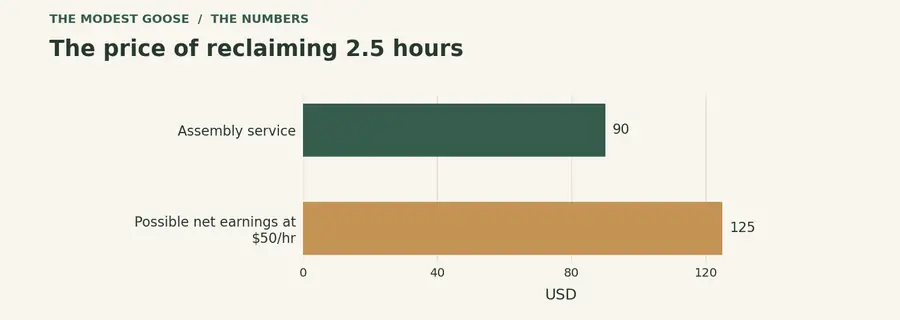
You wouldn’t quite reclaim all three hours. Subtract the half hour needed to arrange the service and you’re buying back 2.5 hours. At $90 ÷ 2.5, each of those hours costs $36.
If you actually have paid work available that earns $50 an hour after the extra costs, those hours could earn $125. You would be $35 ahead after paying the assembler, before any other differences. But the word ‘actually’ is doing the heavy lifting here. Watching television is probably not going to generate $125, though it might still be a perfectly lovely way to spend the evening.
If you cannot earn extra income, the calculation is still useful. You now know the price of reclaiming the time: $36 an hour. You can decide whether a less stressful afternoon is worth that to you and whether your cash budget permits it.
Learning, earning and the value of doing nothing
Consider the longer-term alternatives as well as immediate earnings. A course might consume 40 hours but improve your future options. An extra shift might produce immediate cash but reduce time available for study or recovery. Neither choice is automatically superior.
I would be particularly cautious about treating every non-working hour as lost earnings. That assumes paid work is always available and that rest contributes nothing to your life. Both assumptions deserve rather more scrutiny than they usually receive.
The test I would use
Write down the two realistic alternatives, calculate the incremental money and net hours involved, and consider which important activity would actually benefit. If the time saving is recurring, assess it over several months. If the purchase would create financial pressure, the benefits of saving time may not justify the cost.
An hour on Saturday isn’t an hour on Monday
This is one reason I would avoid setting one permanent hourly value and applying it to every decision. The calculation can be useful when comparing two ways of accomplishing the same task, particularly if there is a genuine financial alternative. But the value of spending time with family, resting or learning something interesting does not have to be constant, and it does not have to be converted into money.
The recurring-expense calculation
A recurring service or tool can be evaluated over the period in which you realistically expect to use it. Suppose a service costs $20 a month and saves 40 minutes of work per week, after accounting for any time needed to use the service. Assume you benefit for 48 weeks during the year.
The annual cost is $240. The estimated time saved is 40 minutes multiplied by 48 weeks, or 32 hours. That works out to $7.50 per hour saved. If the service genuinely removes that amount of effort, it may be an appealing trade-off. If it only saves ten minutes a week, the annual saving falls to eight hours and the cost rises to $30 per hour saved.
The second estimate is worth considering because time savings can be overstated. A service that performs a task automatically may still require setup, corrections or review. A new tool might save time once the workflow is established but take considerable effort to learn. Include the practical costs of using it before concluding that the quoted savings will materialise.
Then check whether the recurring expense fits your budget. A purchase can represent good value per hour saved while still being unaffordable at the moment. The financial and time constraints both deserve attention.
What a job offer costs in hours
A higher-paying role may require additional hours, travel or availability outside the normal working day. A useful comparison is to calculate the additional usable income and divide it by the additional time commitment. That tells you something about the financial trade-off, provided you are using realistic estimates of both pay and hours.
But the resulting hourly figure should be interpreted alongside the alternatives you would give up. An extra ten hours each week could reduce the time available for a course, a side business or important personal commitments. It might also have an effect on how sustainable the job feels. Those considerations cannot always be captured fully in a compensation model.
I would use the same approach when considering an opportunity to earn more money outside work. Calculate the realistic amount remaining after direct costs, then estimate the time needed to obtain and deliver the work. Compare that with the other activities you would otherwise choose. If you value the experience or enjoy the project, the immediate hourly return need not be the only criterion.
Ultimately, the usefulness of opportunity cost is that it reminds you there is a choice. Even when you do not spend any money, you are committing something that cannot be recovered later. That does not mean your day should become a relentless exercise in optimising every minute. It means you can be a little more deliberate about where your time goes, particularly when a recurring obligation or an apparently attractive saving starts to displace things you care about.
Some things are worth doing yourself because you enjoy them. Others are worth paying for because you don’t. I wouldn’t make that decision solely from an hourly wage; I would make it from the kind of day I want to have.
Education only, not financial advice. This article is general information, not a recommendation to buy, sell or hold anything. Examples are illustrative. Check current rules for your country, and consider a licensed adviser for decisions about your own situation. Full disclaimer.