 The Modest Goose
I like borrowing a few habits from well-run businesses. They tend to know how much money is coming in, how much work they have promised to do and whether their plans fit the available resources. It strikes me as odd that we can spend all day doing this at work and then come home and hope for the best.
That doesn’t mean treating your family like shareholders or measuring the financial return on your holiday. I would borrow the simple habits that give you visibility, and leave the rest at the office.
The useful habits to bring home
Three habits stand out: maintaining accurate financial records, allocating resources before committing them and reviewing what actually happened. These are not exclusively business habits, of course. They are simply useful ways of avoiding decisions based on incomplete information.
For personal finances, keep a balance sheet and a simple cash forecast. For tasks, keep one list of real commitments and a calendar that reflects the time available. For goals, review progress periodically and change the plan when the underlying circumstances change.
When the money and time budgets disagree
Suppose a person has $1,200 available each month after essential expenses and six discretionary hours a week after fixed commitments and rest. They want to save $800 monthly for a move, spend $500 on a new course and use eight hours a week on personal projects.
The move and the course together ask for $800 + $500 = $1,300. The available cash is $1,200, leaving a $100 gap. The time plan has eight hours of projects and six hours in which to do them, leaving another gap of two hours.
Something has to move. I would postpone or reduce one of the cash commitments and trim a project’s scope or extend its schedule. The numbers aren’t telling us which ambitions matter most. They’re helpfully pointing out that we cannot pretend they all fit.
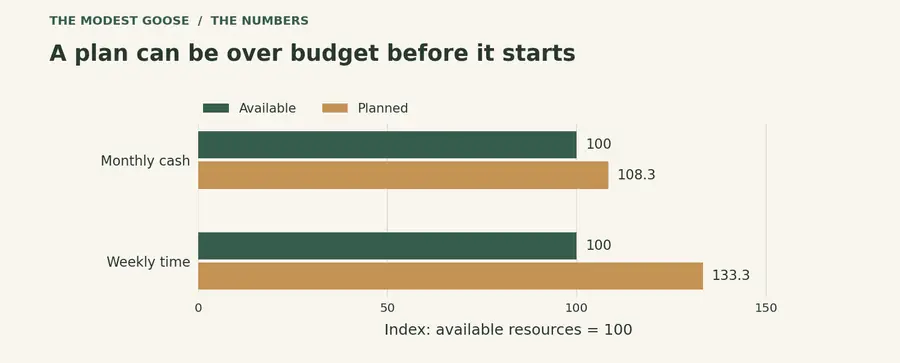
This is one of the more useful things about a spreadsheet. It is fairly indifferent to whether you really wanted both things. It will still point out that $1,300 is greater than $1,200.
The management practices I would leave behind
Your relationships are not performance indicators. Your holidays do not need quarterly growth targets. You do not need a budget variance meeting every time you decide to have a nicer dinner than usual. Some things are valuable precisely because you are not trying to maximise their measurable output.
I would use structure where it reduces anxiety, missed obligations or unnecessary work. Leave plenty of room for spontaneity, rest and things that don’t require a compelling commercial case.
A routine that doesn’t need a meeting invitation
Update your finances once a month. Review active commitments once a week. Revisit larger goals every quarter. Give each review a specific purpose and finish with a decision rather than another report. If the routine stops helping, make it smaller.
A little structure around your money
A basic financial record can tell you quite a lot without requiring the full apparatus of company accounting. A balance sheet shows what you own and owe. A cash-flow statement records money coming in and going out, while a forecast shows what might happen over the coming months. These are simple but complementary ways to understand your finances.
I would keep the reporting purpose practical. If the household is considering a major purchase, the forecast can reveal whether the timing is affordable. If a change of employment is under consideration, the balance sheet can show how much accessible cash is available to support the transition. If spending has increased recently, a comparison of monthly cash flows can help identify why.
Time is a constraint, not a commodity
Time, like money, is limited. Committing it to one activity can make it unavailable for another. A calendar and task list can reveal these trade-offs in a similar way to a cash forecast, even if you never assign an hourly financial value to your personal time.
Suppose you have several projects you would like to complete outside work. List the actual tasks required and estimate the time involved. Compare that total with the hours available after fixed commitments and the rest you want to protect. If the plan does not fit, decide which project deserves attention first rather than assume you will somehow become more efficient every week.
The analogy with a budget is useful, but it has limits. You cannot save an unused hour in a bank account and retrieve it next month. You also do not have the same amount of energy available during every hour of the day. A good plan considers when particular work can reasonably happen and leaves room for the parts of life that are valuable without being productive in the usual sense.
Life doesn’t need quarterly earnings calls
I would be particularly cautious about the tendency to create measures simply because the software makes them easy to produce. Tracking every detail of a project can be useful in a large organisation where several people need to coordinate their decisions. For an individual, the same reporting effort may add very little value. The more important question is whether the information helps you decide what to do.
There is also a danger in borrowing the expectation that everything should grow continuously. You may be perfectly happy with the amount of money you earn, the commitments you maintain or the number of projects you are working on. Adding more simply because the previous period went well is not necessarily a good decision. A stable arrangement that leaves you with enough time and financial flexibility can be a desirable outcome in its own right.
The habits matter more than the tools.
The goal is not to turn yourself into a terribly efficient company. It is to have enough visibility to make good decisions, enough money for the things that matter and enough time to enjoy them. That seems to me a rather better definition of being well managed.
Education only, not financial advice. This article is general information, not a recommendation to buy, sell or hold anything. Examples are illustrative. Check current rules for your country, and consider a licensed adviser for decisions about your own situation. Full disclaimer.