 The Modest Goose
A personal operating system sounds like the sort of thing that ought to involve an elaborate dashboard and possibly its own logo. I prefer the less exciting version: somewhere to write commitments down, a calendar that reflects reality and a habit of checking where the money and time went.
The point is to stop keeping your entire life in your head. A few simple records can do that without requiring you to become the unpaid systems administrator of your household.
Three parts of a system that actually helps
I would start with four things: a calendar, a task tracker, a place for reference notes and a short review routine. If you manage your own finances, add a balance sheet and a cash-flow plan. You do not need a single app containing everything. The pieces simply need clear responsibilities.
Your calendar records time commitments. Your task tracker records next actions. Your notes store information you might want again. Your financial records answer questions about money, not whether you remembered to water the plants. Keeping each function separate makes the system easier to maintain.
Connect ambitions to the next action
A goal is an outcome you want, such as improving fitness, applying for a new role or saving for a move. A project is a collection of actions intended to achieve it. A task is the next action you can actually perform.
For example, ‘find a new job’ is not a particularly useful evening task. ‘Identify three roles that meet my salary and commute criteria’ is much more manageable. Give important goals a next action, and avoid starting more projects than your time allows.
The eight-hour personal week
Suppose someone has eight discretionary hours in a normal week after essential commitments and protected rest. They want to spend three hours on a course, two on a side project, one on household admin and one on exercise outside existing routines.
Three hours for the course, two for the side project, one for household admin and one for exercise add up to seven hours. With eight available, we have an hour that hasn’t been promised to anyone.
Put the course and project time into the calendar, capture the admin in a task list, and resist the temptation to immediately fill that final hour. An unallocated hour is a useful resource, not a hole in your productivity statistics.
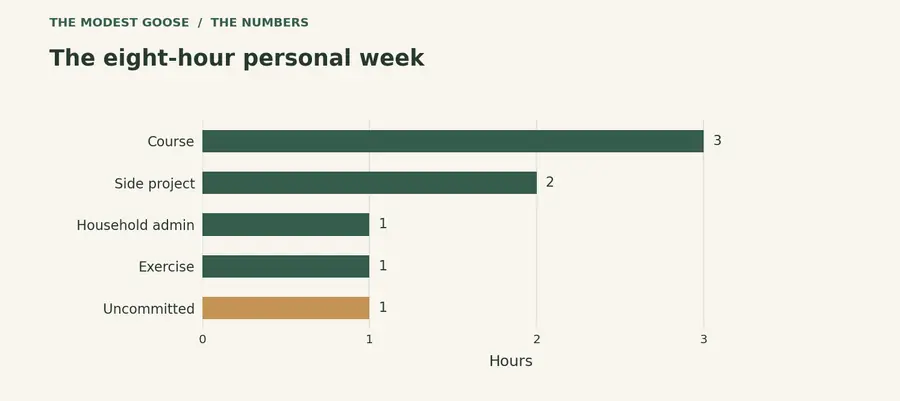
The extra hour is not an invitation to create another project. It is useful room for things that inevitably take longer than expected.
The habits that keep it working
Once a week, review upcoming appointments, open tasks and ongoing projects. Once a month, review finances and major goals. Once a quarter, reconsider priorities and stop projects that are no longer useful. You can adjust the cadence if your circumstances change.
I would avoid tracking things just because they are measurable. If daily scoring makes exercise or leisure feel like another work assignment, it is not helping. The system should reduce the mental effort of living an ordinary life, not turn the ordinary life into an enormous reporting exercise.
Where a new commitment should go
This distinction helps prevent the system from becoming a collection of disconnected information. Each tool holds the part of the information that serves its purpose. You can use a short reference to locate the original document when needed. Keep the references simple enough that you will still understand them several months later.
I would also make a clear distinction between active commitments and possible ideas. Perhaps you have a list of courses you would like to take, places you would like to visit and projects you might start. These do not all deserve a due date. Keep them available for a future review rather than turn them into a large collection of apparently unfinished obligations.
You can build the whole thing in spreadsheets
Yes, particularly if the questions you want to answer are reasonably structured. A task workbook can record actions, due dates and projects. A financial workbook can record assets, liabilities and planned cash movements. A simple goals sheet can record important outcomes and the next actions associated with them. The calendar can remain the place where scheduled appointments and protected time are held.
You do not necessarily need all the workbooks to be technically connected. If the weekly review asks you to check whether an upcoming commitment requires time or money, you can move between the relevant records manually. For an individual, that may take less effort than building an integration that needs maintenance every time the structure of a file changes.
If the system includes work-related commitments, take confidentiality seriously. Use only the information and tools permitted by the employer, and avoid storing confidential work documents or customer information in a personal workspace. A general calendar block saying that you are unavailable may be sufficient for planning your personal time. You do not need the details of the work in order to know that the time is committed.
Try it for a month before redesigning it
During the next couple of weeks, add a basic financial review if you do not already have one. Record the important balances and upcoming payments rather than trying to build a complete accounting system. Then choose a small number of goals for the coming months and define an actionable next step for each. The objective is to get the system working before adding extra detail.
At the end of the first month, review the system itself. Did it help you remember anything important? Did it make it easier to decide what to do with limited time? Did the financial record reveal something you would otherwise have missed? If the answers are positive, retain the useful parts. If the maintenance feels disproportionate to the benefit, simplify it.
I would judge a personal operating system by how well it works on an ordinary, inconvenient Tuesday, not by how impressive it looks on a quiet Sunday afternoon. You should be able to open it, understand what needs attention and get on with the actual work of living your life. The less ceremony required to accomplish that, the better.
If a system gives you a quieter mind and a slightly less chaotic week, it is doing plenty. It doesn’t have to make you an exceptionally productive human being. Being a reasonably organised one is quite enough.
Education only, not financial advice. This article is general information, not a recommendation to buy, sell or hold anything. Examples are illustrative. Check current rules for your country, and consider a licensed adviser for decisions about your own situation. Full disclaimer.