 The Modest Goose
Three months is long enough for something meaningful to happen and short enough to admit that an ambitious January plan hasn’t quite survived contact with reality. I like a quarterly personal review for exactly that reason.
Look at your money, your major goals, your time and the things that have changed since the previous quarter. Not to give yourself an annual performance rating four times a year, but to decide whether the plan still deserves the next three months.
Review the things that matter to you
I would look at four broad areas: money, career, personal projects and everyday wellbeing. For money, compare net worth, accessible cash and significant upcoming expenses. For career, consider new responsibilities, skills and opportunities. For personal projects, identify what was actually delivered rather than what was planned. For wellbeing, reflect on routines and commitments in a way that supports you rather than turns health into a performance rating.
Each area needs only a few useful observations. You do not need a chart for every aspect of life. If a metric does not help you make a decision, leave it out.
A quarter that didn’t quite go to plan
Compare what happened with what you expected, then identify the reason for the difference. Some goals were unrealistic; others became less important because circumstances changed. A review should make room for those facts rather than mechanically categorise everything as success or failure.
Suppose you planned to finish a 30-hour course, save $3,000 and spend 12 hours on a personal project. After the quarter, you have completed 18 course hours, retained $2,400 and spent 15 hours on the project.
Eighteen of thirty course hours are done, or 60%; twelve remain. Savings of $2,400 against $3,000 amount to 80% of the target, a shortfall of $600. The project used fifteen hours against twelve planned, or 125% of the time allowance.
I would not put a green tick against the project simply because it received more hours. Did anything useful come out of those hours? Likewise, the savings shortfall could be a perfectly reasonable consequence of an unexpected expense. The figures tell you which questions to ask, not whether you were a good person this quarter.
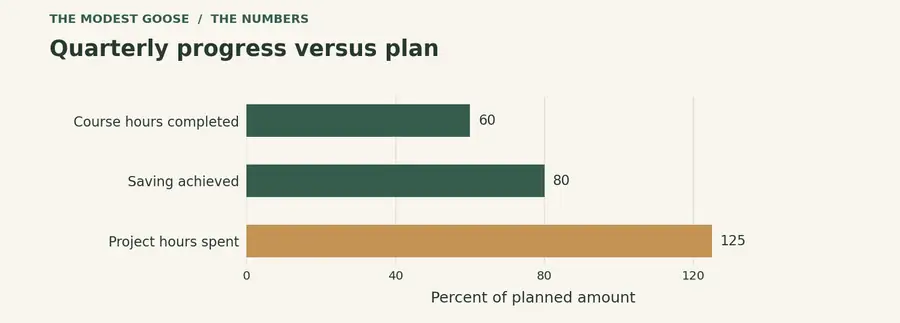
Perhaps a major unexpected expense explained the savings gap and the course requires another six weeks. The numbers help you decide what to adjust. They are not grades.
What deserves the next three months?
Choose a small number of outcomes. Estimate what each requires in time or money and compare them with your actual capacity. If you want to finish the course, reserve the remaining hours. If the side project is not yielding useful results, consider pausing it. If a savings target is now unrealistic, adjust the amount or timeline.
I like ending a review with three questions: what should continue, what should change and what can stop? The third question is particularly useful if you tend to collect projects faster than you finish them.
Gather the evidence before deciding
The review will be more useful if you have a few actual records rather than relying entirely on how the previous three months felt. For finances, collect the opening and closing balances, income received, major expenses and any material changes in liabilities. For personal projects, look at what was delivered and which commitments remain unfinished. For career development, consider any meaningful changes in responsibilities, skills or options available to you.
I would read the goals you set at the beginning of the quarter before deciding whether the quarter was successful. It is surprisingly easy to change the definition of success after seeing the outcome. Sometimes that reflects a perfectly reasonable change of circumstances. Recording the reason helps distinguish a conscious change in direction from a goal that was quietly forgotten.
The market doesn’t report to you
A quarterly increase or decrease in net worth may reflect market movements, changes in property estimates, currency movements or a major expenditure. It does not necessarily tell you how successfully you managed the ordinary household budget. Look at the components of the change before drawing conclusions.
For example, someone may have saved consistently throughout the quarter but experienced a fall in the market value of their investments. Another person may have spent more than intended but benefited from a market rally. The headline balance sheet numbers could suggest the opposite of what actually happened in their day-to-day finances.
The same principle applies to other goals. A period of family responsibilities or unusually demanding work may have reduced the time available for a course or personal project. That does not necessarily make the original goal a poor one. It may mean the schedule needs to change, or that the goal belongs in a different season of life.
A small number of actual priorities
I like to start with the commitments that already exist. Identify any major expenses, deadlines, travel or personal responsibilities that are likely to affect the coming quarter. They determine how much time and money is available for additional goals. Then consider the projects you would like to continue or start.
For each proposed priority, describe what a satisfactory outcome would look like by the end of the quarter. Estimate the effort or funding required and identify the first meaningful action. If several goals compete for the same limited resource, make that trade-off explicit. A plan to spend ten hours a week on personal projects is not very useful if the next quarter realistically offers four.
Some goals may need a shorter review interval. If you are testing a new side business, for instance, you may want to assess customer feedback or revenue more frequently. A larger career decision may require occasional research rather than a weekly performance target. Match the review frequency to the information that is actually likely to change.
I would finish with a short written record of the decisions. Keep the few priorities you intend to pursue, note anything you have deliberately paused and identify the next actions. The review does not need to become another large project in its own right. Its purpose is to prevent you from spending the next three months following a plan that no longer fits your life. A modest, realistic plan that you revisit when necessary is often more valuable than an ambitious document that remains unchanged until the end of the year.
A quarterly review should leave you with a clearer plan and fewer unnecessary commitments. If it mainly leaves you feeling guilty about a version of your life that no longer exists, revise the plan rather than the person.
Education only, not financial advice. This article is general information, not a recommendation to buy, sell or hold anything. Examples are illustrative. Check current rules for your country, and consider a licensed adviser for decisions about your own situation. Full disclaimer.