 The Modest Goose
The 20-Minute Weekly Personal Review
Sunday evenings already have enough to answer for. I wouldn’t recommend adding a two-hour meeting with yourself to the list. But twenty minutes looking at the coming week can prevent a surprisingly large amount of unnecessary panic.
A weekly personal review is a chance to see what’s unfinished, what you’ve promised and what will actually fit. The interesting part is usually not discovering what you should do. It is realising what you shouldn’t try to do this week.
The commitments worth reviewing
Start with your calendar and task list. Check what you finished, what is waiting on another person and what has a genuine deadline soon. Look at personal commitments as well as professional ones, while keeping any confidential work details in the appropriate employer-approved tools.
Then look at the projects that matter beyond the next seven days. Are you making progress, or simply moving the next action from one week to the next? If a project has stalled, decide what would move it forward. You do not have to complete everything.
Twenty minutes with a calendar and a list
Spend five minutes capturing loose commitments from notes, messages and memory. Spend another five updating task status and checking upcoming deadlines. Use five minutes to estimate your available time and choose the most important actions. Finally, spend five minutes scheduling focused work and removing or deferring anything that does not fit.
Suppose next week you have six hours free outside fixed responsibilities and rest. Your list contains two hours of household admin, three hours for a personal course, two hours for a side project and one hour for sorting files.
The list asks for 2 + 3 + 2 + 1 = eight hours. The calendar has six. I would give two to household admin, three to the course and one to the side project. The final hour of side-project work and the file sorting can wait.
There is no special merit in carrying a two-hour shortfall into Monday and hoping someone cancels dinner. If a task becomes more important, swap it into the plan explicitly.
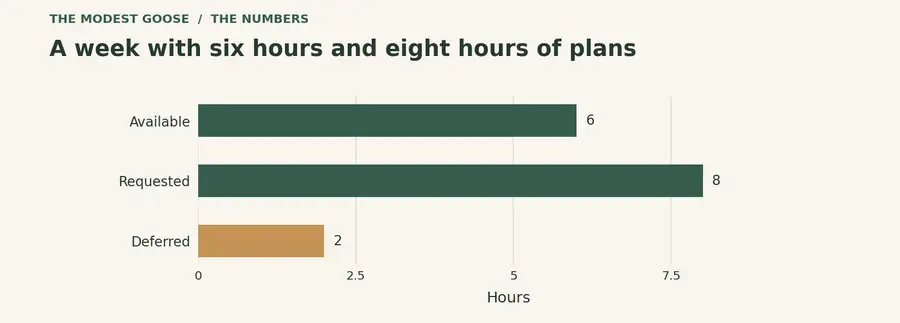
You have not become less productive by admitting that eight hours will not fit into six. You have simply made a more accurate plan.
The things left over from last week
Avoid treating every unfinished task as a failure. It may have been too large, poorly defined, dependent on someone else or simply less important than something that arrived unexpectedly. Break down anything vague, follow up on waiting items and delete commitments that no longer serve a purpose.
If the same project appears week after week without progress, consider whether you genuinely want to keep it active. A paused project is more honest than a permanently overdue one.
I would keep a simple list of the coming week’s two or three meaningful outcomes. That gives you something to aim for without turning Sunday evening into a three-hour planning session.
A review isn’t quite the same as a plan
Look at the unfinished work first. Was it delayed by an unexpected obligation, or was the original estimate simply too optimistic? Did the priority change? Was a task waiting for information you never requested? The answer affects what you should do next. Moving the task to the following week without addressing the reason for the delay may simply repeat the same problem.
Then look at the coming week’s calendar. Count the time that is genuinely available rather than assuming the week has the same capacity as every previous week. A family event, travel or an unusually demanding work period may mean you have less time for personal projects. Reducing the plan is a reasonable response to a different week, not evidence that the system has failed.
Give next week a realistic amount of work
Next, choose a small number of outcomes for the week. For example, completing the first module of a course and sending the documents required for a household application are clearer outcomes than vaguely hoping to make progress on six projects. You can list the supporting actions beneath them or identify them using a project column in the task tracker.
If new work arrives during the week, revisit the plan rather than continually adding to it. Decide whether an existing task should move or whether the new request can wait. This is a useful habit for avoiding the situation where you have kept every commitment in theory but have quietly run out of time to keep any of them in practice.
When a project has been stuck for a month
I would ask whether the project still matters, whether the next action is sufficiently clear and whether it has been allocated any real time. If the task is waiting for someone else, identify the follow-up. If you no longer have a reason to do it, mark it paused or remove it. If the objective remains important but the first step is too large, define a smaller one.
For instance, a project called ‘organise household finances’ may sit on the list indefinitely because it sounds like a significant undertaking. You could replace the next action with ‘collect the balances of all savings accounts’. Once that is done, add the next action. The project becomes a series of manageable decisions rather than a recurring source of guilt.
The weekly review is also a chance to check whether the balance between your obligations and personal time is sustainable. If the plan repeatedly leaves no space for rest, consider what can be reduced rather than assume that the solution is better discipline. A review that merely encourages you to work longer hours each week has probably missed its purpose.
I would keep the review record short: one note about what changed, the next important commitments and perhaps a decision to stop or defer something. The real value of the routine is remembering the things you have committed to and making fewer unrealistic promises to yourself. Once you have done that, close the tracker and enjoy the rest of the evening.
There is something rather satisfying about beginning Monday without pretending you have an extra eight hours tucked away somewhere. Take a sensible amount of work into the week and leave room for the things that haven’t happened yet.
General information. This article shares ideas and examples for organising work and life. It is not professional advice. Full disclaimer.