 The Modest Goose
I suspect most of us would quite happily accept a $200,000 salary. It sounds like the sort of income that ought to solve a number of problems. The trouble is that a salary doesn’t automatically arrive with a financially sensible lifestyle attached.
The number I would be most curious about is what remains after tax, housing, transport, family commitments and all those modest upgrades that somehow become permanent. High income is an enormous advantage. It is not, by itself, wealth.
Income is the tap, wealth is what stays in the bath
Income is a flow of money over time. Wealth is a stock of accumulated assets after subtracting debts. A salary arrives each month; a balance sheet records what remains. A household may earn a lot and have very little flexibility if it has high fixed commitments.
This isn’t an argument against enjoying your earnings. Someone paying for childcare or supporting relatives may have perfectly sensible reasons for spending more than someone with fewer responsibilities. Comparisons without context rarely tell you much.
The less impressive salary that saves more
Suppose two households have gross annual salaries of $200,000 and $120,000 respectively. Assume their actual annual cash receipts after payroll deductions and tax are $135,000 and $90,000. These are made-up take-home figures, not US tax calculations.
Household A spends $118,000 on annual living costs and other outflows. Household B spends $60,000.
Household A keeps $135,000 − $118,000 = $17,000, or 12.6% of cash income. Household B keeps $90,000 − $60,000 = $30,000, or 33.3%.
At the end of five years, with no growth, inflation or raises, the larger earner has set aside $85,000. The smaller earner has accumulated $150,000. The difference is $65,000. Of course the person earning $200,000 has a tremendous opportunity to change this result. It just requires some of the extra pay to survive the month.
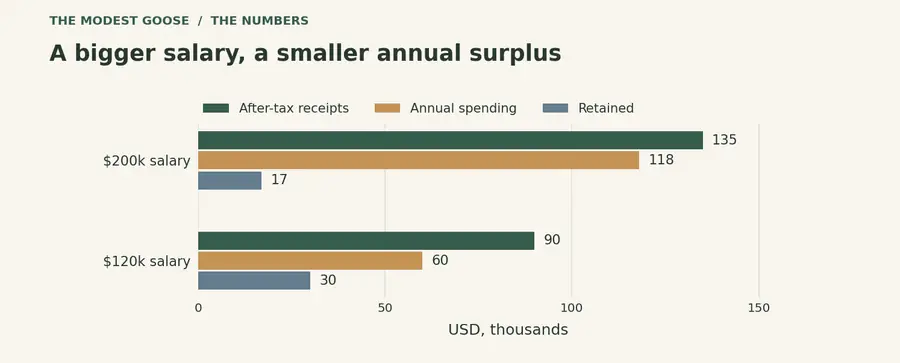
The lower-income household retains $65,000 more. This doesn’t make B morally superior, and it doesn’t imply everyone can replicate that budget. It simply demonstrates the importance of what happens after the salary arrives. Employer retirement contributions and home equity changes are not included in this comparison.
The cost of getting used to nice things
Lifestyle inflation occurs when spending rises as earnings rise. It can be hard to notice because many changes are perfectly reasonable in isolation: a larger home, a more convenient commute, better holidays or an extra subscription. The danger is not buying any of these things. It is committing all of the increase before deciding what you wanted the increase to accomplish.
I find recurring costs more interesting than occasional treats. A $500 monthly obligation commits $6,000 a year. If it is difficult to unwind, it can also make changing jobs or taking time off harder. That loss of flexibility deserves a place in the decision.
A better measure of financial progress
Look at four numbers: annual take-home pay, annual amount retained, net worth and essential monthly expenses. Compare them year on year. If income rises significantly but retained money and flexibility remain unchanged, ask whether the additional spending was a conscious choice.
There is no particular reason to aim for the lowest possible spending. What I would avoid is accidentally buying a more expensive life while imagining I am buying freedom.
The monthly bills deserve more attention than coffee
One difference between a high-income household and a financially flexible one is how much of next month’s income has already been committed. Housing, vehicle financing, insurance, childcare and contractual payments can absorb a large share of income before anyone has decided where to go for dinner.
Suppose a household adds another $900 of recurring monthly commitments after receiving a raise. That is $10,800 a year. If the household later wants to move to a less demanding role, the new obligations may make that transition much harder. An equally expensive one-off holiday has a different effect because the household does not have to repeat it the following year.
I am not suggesting that expensive housing or childcare is automatically unnecessary. Location, family responsibilities and quality of life are perfectly legitimate reasons to spend money. I would simply give a recurring commitment more scrutiny than an occasional purchase, because the decision reaches much further into the future.
A bonus isn’t a fixed salary
The two households in the earlier example have simplified salaries. In real life, substantial bonuses and stock awards can make the gap between annual gross compensation and dependable monthly cash even more important. A $200,000 compensation package might include a much smaller base salary alongside variable income or equity scheduled to vest later.
If you use the full package to estimate affordability, you can end up committing recurring expenses against money that may not arrive. Build the ordinary monthly budget using dependable take-home income, then show potential bonuses or equity separately. Even a generous annual bonus may do little to cover a cash-flow shortfall several months before it is paid.
This is particularly relevant when considering a large mortgage, private school costs or other commitments that cannot easily be reduced. A household can be prosperous under its central compensation assumption and surprisingly vulnerable under a more modest one. The spreadsheet should show both possibilities.
What I would look at once a month
Finally, ask what you wanted the higher income to achieve. Perhaps the objective was to fund education for children, create the option to change careers or simply worry less about money. Those are more helpful measures than whether you have reached an arbitrary salary milestone. High income creates options, but only to the extent that some of it remains available after you have paid for the life you choose to lead.
I would rather see an increase in income used deliberately than insist every additional dollar be saved. The useful question is whether you can explain the trade-offs you have made, and whether they still reflect what you want. An impressive salary is a means to that end, not the end itself.
I would never say a larger salary doesn’t matter. Of course it does. I just think the best thing it can buy is more choice in the future, rather than a longer list of things you need the salary to maintain.
Education only, not financial advice. This article is general information, not a recommendation to buy, sell or hold anything. Examples are illustrative. Check current rules for your country, and consider a licensed adviser for decisions about your own situation. Full disclaimer.